Knowledge Test Class A #1
Class A Driving Test | New York 2026 #1 Page 7 of 7
Train for FREE online with our New York class A license test. The official exam test consists of several obligatory parts, with all of them checking your knowledge of different blocks of road rules. If you need to obtain a NY CDL class A permit in 2026, practice as much as possible. Free sample tests published on our website will help you check and improve your knowledge and boost your grades. Please bear in mind that CDL class A requirements may vary from state to state.
50
40
20
43 . If a vehicle is equipped with power steering, the hoses should be checked:
To ensure that they contain the proper amount of play.
When inspecting a vehicle with power steering, you should inspect the hoses, pumps, and fluid levels. Specifically check the hoses for leaks.
44 . When checking your vehicle's lights before driving:
The check can be done by looking at a reflection from a shiny surface.
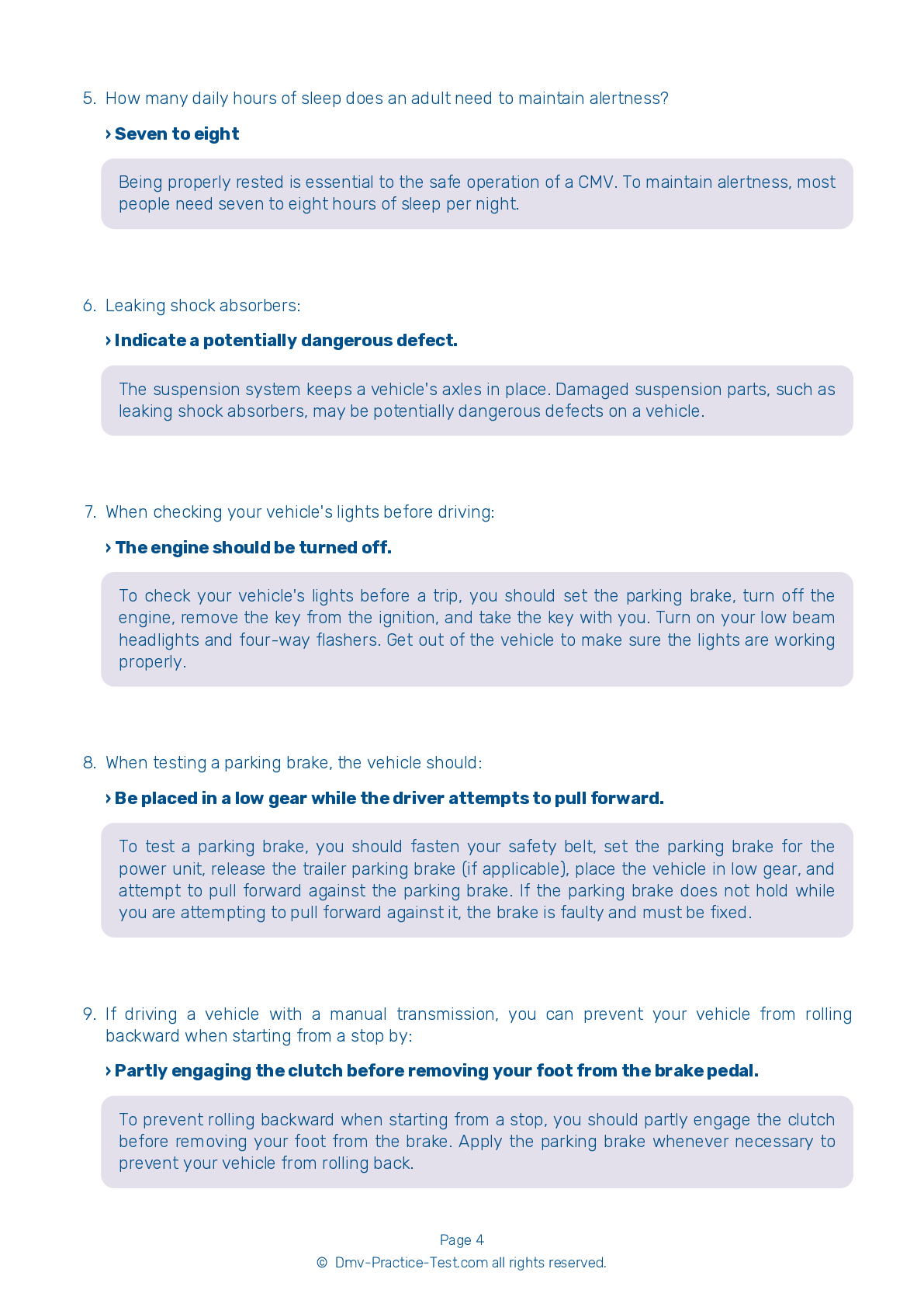
To check your vehicle's lights before a trip, you should set the parking brake, turn off the engine, remove the key from the ignition, and take the key with you. Turn on your low beam headlights and four-way flashers. Get out of the vehicle to make sure the lights are working properly.
45 . Overloading cargo can have negative effects on all of the following, except:
The electrical system.
Overloading a vehicle can have negative effects on its steering, braking, and speed control. Be aware of how your vehicle handles differently when carrying additional weight.
46 . Why should your mirrors be adjusted to show the road behind you as well as part of your vehicle?
The driver should be able to see the reflection of surrounding vehicles on the trailer.
Part of your vehicle should be visible in your mirrors so that you have a point of reference when judging how close other drivers and objects are to your vehicle.
47 . When encountering fog, you will be safest if you:
Follow the vehicle ahead of you closely.
Fog can quickly deteriorate drivers' ability to see the road, other drivers, and other hazards. Avoid driving in fog if at all possible.
48 . If an aggressive driver confronts you, you should not:
Try to get out of their way.
When confronted with an aggressive driver, your first priority should be to get out of their way. Do not provoke the driver by making eye contact, trying to race, or refusing to move out of your traffic lane. Additionally, ignore any gestures that are intended to provoke you.
49 . When other vehicles have trouble seeing you at dawn or dusk, you can increase your visibility by:
Turning on your windshield wipers.
At dawn or dusk, and in snowy or rainy conditions, you should turn on your headlights to make it easier for other road users to see your vehicle.
50 . When driving, the steering wheel should be:
Held with both hands at the top of the wheel.
Hold the steering wheel firmly with both hands, placing them on opposite sides of the wheel.
Search the best driving school in your neighbourhood
2026 New York | Frequently Asked Questions
A CDL Class A license in New York allows the holder to operate any combination of vehicles with a Gross Vehicle Weight Rating (GVWR) of 26,001 pounds or more, given that the GVWR of the vehicle(s) being towed is in excess of 10,000 pounds. This typically includes tractor-trailers and truck and trailer combinations.
A Class A CDL license in New York allows the operation of a variety of vehicles such as tractor-trailers, truck and trailer combinations, tank vehicles, livestock carriers, and flatbeds. It also includes any combination of vehicles with a Gross Vehicle Weight Rating (GVWR) of 26,001 pounds or more if the towed vehicle is over 10,000 pounds.
To obtain a Class A CDL license in New York, applicants must be at least 21 years old (18 for intrastate), possess a valid New York driver's license, pass a vision test, and successfully complete a written knowledge test. They also need to pass a skills test, which includes a pre-trip vehicle inspection, a basic controls test, and an on-road driving exam.
To qualify for a Class A CDL license in New York, you must be at least 21 years old for interstate travel. However, if you are between 18 and 20 years old, you can still obtain a Class A CDL but you are restricted to intrastate travel within New York State only.
Specific endorsements aren't required for a Class A CDL license, but they can enhance your driving privileges. Endorsements include T (Double/Triple Trailers), P (Passenger), N (Tank Vehicles), H (Hazardous Materials), and S (School Bus). Each endorsement requires passing additional knowledge and skills tests.
The Class A CDL skills test in New York encompasses three main areas. First, a pre-trip vehicle inspection to assess your ability to evaluate if your vehicle is safe. Second, a basic controls test to check your understanding of the vehicle's operations. Lastly, an on-road driving exam to demonstrate your driving skills in various traffic situations and maneuvers.
Yes, there are limitations. Class A CDL license holders in New York can't drive vehicles with manual transmission if they took their skills test on an automatic transmission vehicle. Additionally, restrictions may apply if the driver lacks air brake knowledge or fails the air brake component of the general knowledge test. Also, certain endorsements might be necessary for specific types of cargo.
Yes, it's possible to take the written Class A CDL test in languages other than English in New York. The New York DMV offers the written test in multiple languages. However, federal regulations require that all CDL holders understand and read English well enough to converse with the general public, understand highway traffic signs and signals, respond to official inquiries, and make entries on reports and records.
Yes, accommodations can be made for the Class A CDL written test due to disability. New York State Department of Motor Vehicles (DMV) complies with the Americans with Disabilities Act (ADA). You can request special testing accommodations by completing form MV-44.5 "Application for License, Permit, or Non-Driver ID Card" and form MV-80U.1 "Application for an ADA Accommodation."
Yes, if you don't pass the Class A CDL written test in New York, you can retake it. However, there's a waiting period of at least one day before you can try again. Remember, you need to pay a test fee each time. It's advised to study the CDL manual thoroughly before reattempting.