Knowledge Test Class A #1
Class A Driving Test | District Of Columbia 2026 #1 Page 4 of 7
Train for FREE online with our District Of Columbia class A license test. The official exam test consists of several obligatory parts, with all of them checking your knowledge of different blocks of road rules. If you need to obtain a DC CDL class A permit in 2026, practice as much as possible. Free sample tests published on our website will help you check and improve your knowledge and boost your grades. Please bear in mind that CDL class A requirements may vary from state to state.
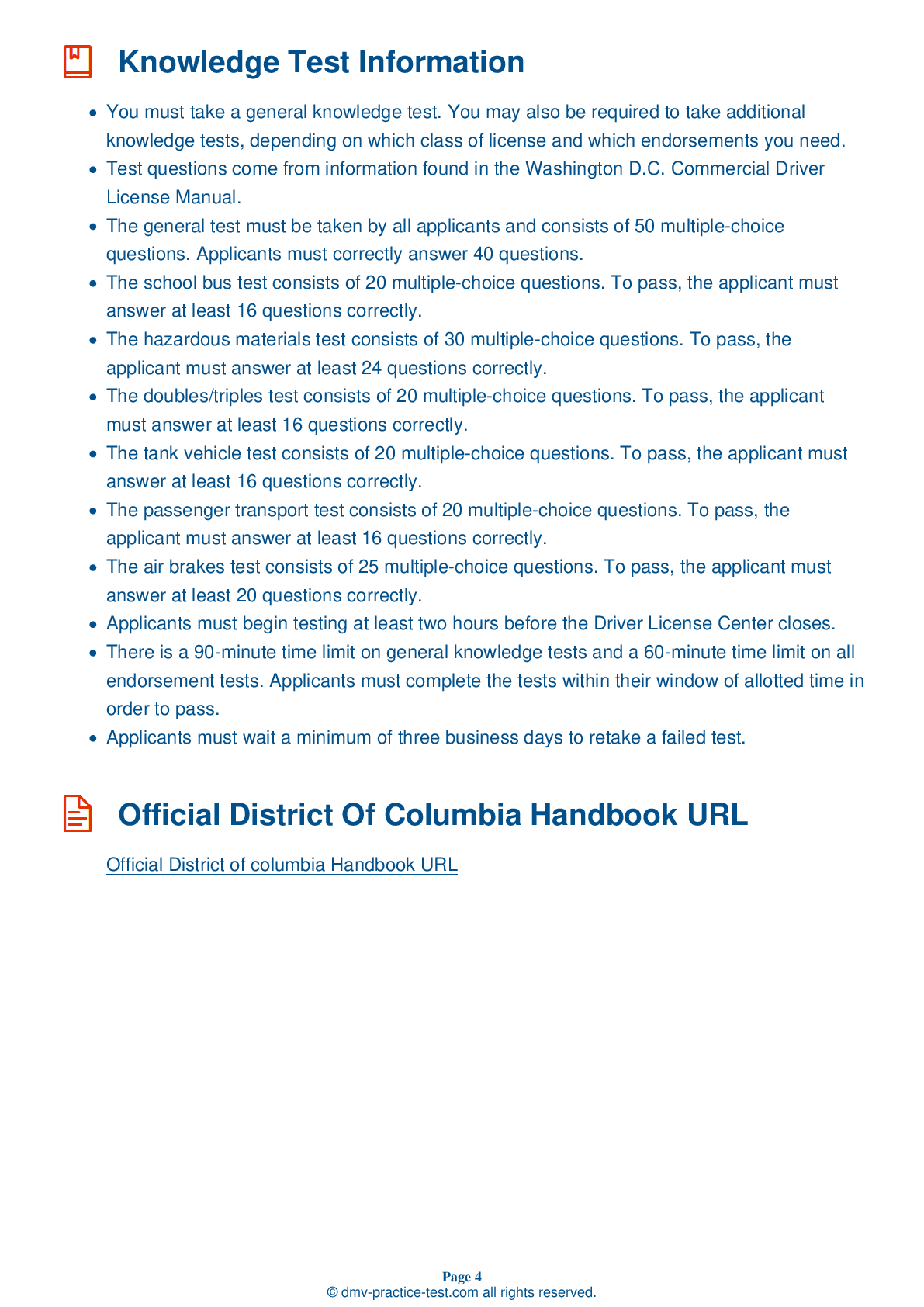
50
40
20
22 . When a vehicle is started, warning lights and buzzers:
Should not come on.
After an engine is started, the warning lights and buzzers for oil, coolant, charging circuits, and the Anti-Lock Braking System (ABS) should go out right away.
23 . Too little weight on a steering axle can result in:
Improved gas mileage.
The weight of cargo in a vehicle needs to be balanced appropriately so that it does not interfere with the vehicle's safe handling. For example, if cargo is placed too far to the rear of a vehicle, the front axle will be under-weighted and the front wheels may not have enough traction for the driver to steer safely.
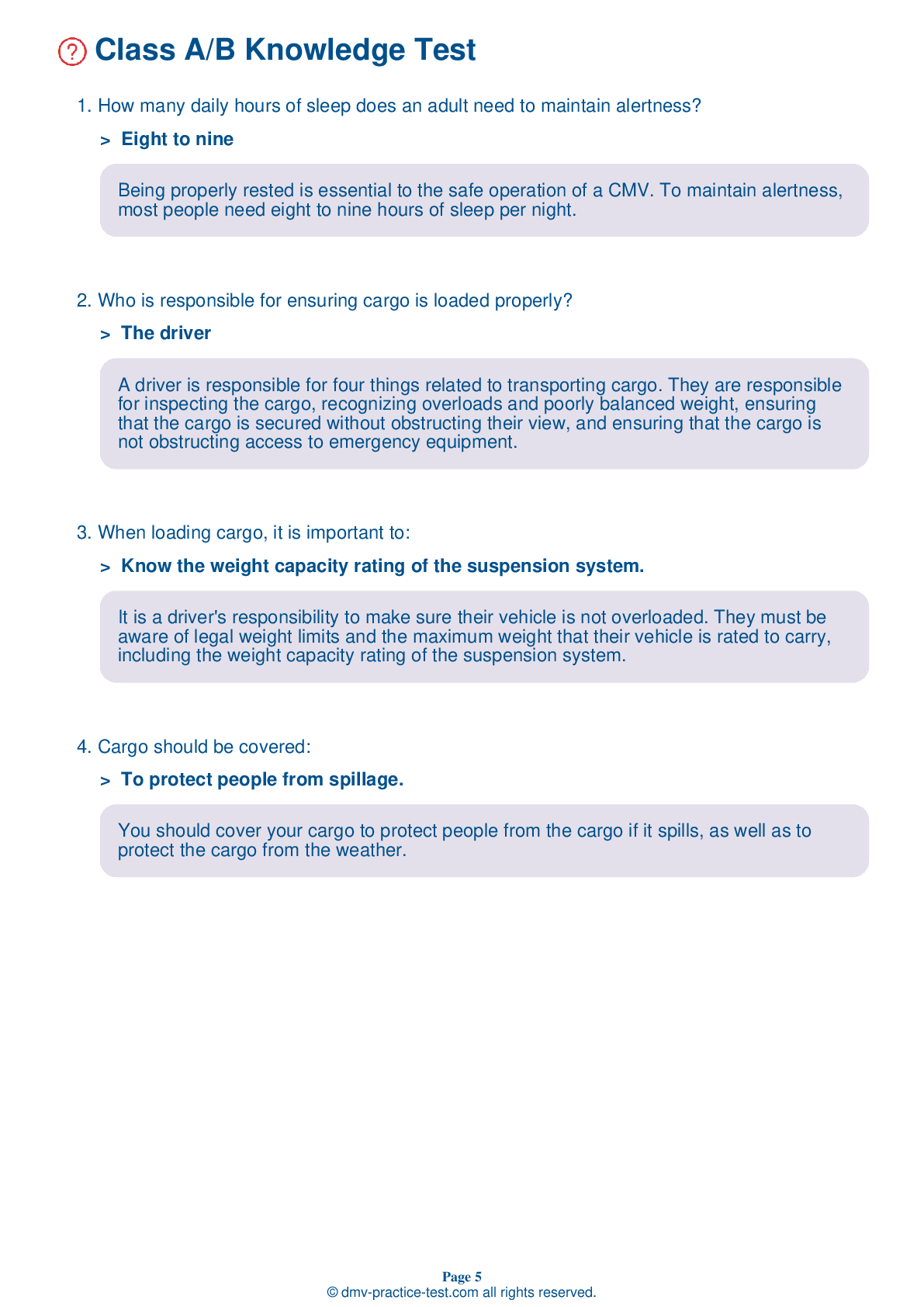
24 . How many daily hours of sleep does an adult need to maintain alertness?
Four to five
Being properly rested is essential to the safe operation of a CMV. To maintain alertness, most people need eight to nine hours of sleep per night.
25 . Sometimes, when checking the automatic transmission fluid level:
Your vehicle may have to be left running.
In some vehicles, you may have to leave the engine running to check the automatic transmission fluid level.
26 . While driving:
A driver should always use turn signals to inform others of their intentions.
It is essential that a driver always uses proper signals to make their intentions known to others on the road.
27 . Brakes can get out of adjustment:
If brakes on one side are used more often than brakes on the other side.
Brakes are particularly prone to getting out out adjustment if they are hot. Use proper braking techniques to avoid letting your brakes overheat.
28 . What is a danger of rolling back when you start to accelerate?
You may lose your position in traffic.
To avoid hitting someone or something behind you, it is important to ensure that your vehicle does not roll backwards when starting from a stop. If your vehicle has a manual transmission, partly engage the clutch before taking your foot off the brake.
Search the best driving school in your neighbourhood
2026 District Of Columbia | Frequently Asked Questions
To acquire a CDL Hazmat endorsement in the District of Columbia, you must first hold a valid CDL. Then, pass the Hazardous Materials Knowledge Test at a DMV service location. You'll also need to undergo a federal TSA background check and fingerprinting. Lastly, submit the Hazmat Endorsement Application, proof of U.S. citizenship or legal status, and pay the required fees.
To obtain a CDL Hazmat license, you must already hold a valid Commercial Driver's License (CDL). You also need to pass the Hazardous Materials Knowledge Test, undergo a federal TSA background check, and be fingerprinted. Proof of U.S. citizenship or legal status is required. Lastly, you need to be in good physical health to meet the demands of the job.
When applying for a CDL Hazmat endorsement, you'll need to provide your valid Commercial Driver's License (CDL), proof of U.S. citizenship or legal residency (like a passport or birth certificate), and proof of identity. You'll also need to bring the receipt for your TSA background check and fingerprinting, and complete the Hazmat Endowment Application.
Yes, there is a dedicated written test for the CDL Hazmat endorsement. This test focuses on the rules and safety procedures for handling and transporting hazardous materials. It's essential to study the Hazmat section of your state's CDL manual thoroughly before taking the test to ensure you're well-prepared.
The written test for the CDL Hazmat endorsement covers a range of topics related to hazardous materials. These include identifying hazardous materials, understanding shipping papers, using placards and labels, handling emergencies, loading and unloading procedures, and complying with the relevant safety rules and regulations.
Yes, there are extra charges associated with acquiring a CDL Hazmat endorsement. These include fees for the TSA background check and fingerprinting, which typically cost around $86.50. Additionally, there may be a fee for the endorsement application, which varies by state. It's best to check with your local DMV for specific costs.
Yes, obtaining a CDL Hazmat endorsement requires a mandatory background check and fingerprinting conducted by the Transportation Security Administration (TSA). This ensures the individual doesn't pose a security threat and is part of the federal safety regulations for handling hazardous materials.
Yes, specialized training is mandatory for the CDL Hazmat endorsement. Applicants must pass a written test that covers the regulations and requirements for transporting hazardous materials. After passing the test, they receive a certification, which is the Hazmat endorsement on their Commercial Driver's License (CDL). This ensures they are knowledgeable about handling hazardous materials safely.
No, you cannot legally transport hazardous materials without a valid CDL Hazmat endorsement. This endorsement ensures that you have the necessary knowledge and skills to handle hazardous materials safely. Driving without it can result in serious penalties, including fines and suspension of your commercial driver's license.
Yes, you can add a Hazmat endorsement to your existing CDL. You don't need to apply for a new CDL. However, you must pass a written Hazmat knowledge test, submit to a TSA background check, and pay the associated fees. Once these steps are completed successfully, the Hazmat endorsement will be added to your CDL.