Special Requirements #1
Special Requirements | Texas 2026 #1 Page 3 of 3
Train for FREE with our Texas CDL practice test online. The official exam test consists of several obligatory parts, with all of them checking your knowledge of different blocks of road rules. If you need to obtain a TX DMV in 2026, practice as much as possible. Free sample tests published on our website will help you check and improve your knowledge and boost your grades. Please bear in mind that DMV requirements for issuing a CDL permit with may vary from state to state.
20
16
22
15 . During the day, if your vehicle is carrying a load that extends more than four feet beyond the rear of your vehicle, you should:
Attach a yellow flag to the rearmost point of the load.
If you are driving during the day while carrying a load that extends more than four feet beyond the rear of your vehicle, you are required to attach a red flag to the rearmost point of the load. The red flag should be at least 12 square inches.
16 . All farm tractors built after 1971 are required to have:
Two electric turn signals.
All farm tractors built after 1971 are required to have two head lamps, two red reflectors, one taillight, and the proper hazard warning lights. Hazard lights should be activated any time the farm equipment is being used on a highway.
17 . You should use ____ when backing your vehicle.
Only the rear vision mirror
When driving in reverse, you should use both rearview mirrors. However, mirrors have blind spots and you should not rely on them entirely.
18 . The load limit for a vehicle may depend on:
The number of axles on the vehicle.
Load limits vary from vehicle to vehicle. Each vehicle's limit depends on its size, the number of axles on the vehicle, the distance between the axles, and the size of the tires on the vehicle.
19 . When a semitrailer is parked on the shoulder of a divided highway, warning signals should be placed:
On the front and rear of the vehicle.
When a commercial motor vehicle is parked on the side of a divided highway, warning signals should only be placed behind the vehicle. They should be placed at distances of 10 feet, 100 feet, and 200 feet from the rear of the vehicle.
20 . After the front wheels of your vehicle pass the corner while you are making a right turn, you should:
Turn wide to the right.
The rear wheels on a long vehicle should have curb clearance when the vehicle is being turned right. To help ensure this clearance, a driver should begin the turn about four feet away from the corner, then turn wide to the right as soon as the front wheels pass the corner. If necessary to avoid the curb, the vehicle may swing into the center lane of the road.
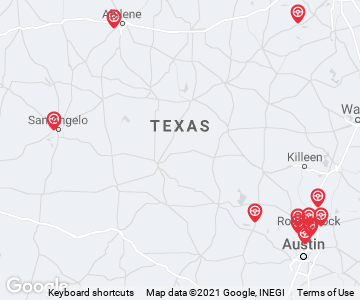
Search the best driving school in your neighbourhood
2026 Texas | Frequently Asked Questions
To acquire a CDL Passenger endorsement in Texas, you must first have a valid Texas CDL. Then, you need to pass the passenger transport test. This involves studying the Texas CDL handbook, especially the sections on passenger transport. After studying, schedule and pass the written knowledge test at a Texas DPS office.
To obtain a CDL Passenger license in Texas, you must meet the following criteria: be at least 21 years old, possess a valid Texas driver’s license, pass a Department of Transportation physical exam, successfully complete a commercial driver's license general knowledge test, and pass a passenger transport test. Also, you must demonstrate your ability to safely operate the type of vehicle you plan to drive.
While specific training isn't legally required to secure a CDL Passenger endorsement in Texas, it is highly recommended. Experience driving large vehicles can be beneficial. You must pass a written knowledge test, and training can help prepare for this. Some opt for professional training programs to gain comprehensive knowledge and practical skills before taking the test.
Yes, to get a CDL Passenger endorsement in Texas, you must pass a written knowledge test specifically for passenger transport. This test covers topics like vehicle inspection, loading and trip start, on the road, after-trip vehicle inspection, prohibited practices, and use of brake-door interlocks. Preparation involves studying the relevant sections of the Texas CDL handbook.
During the CDL Passenger endorsement skills test in Texas, you'll need to demonstrate your ability to inspect the vehicle, load and unload passengers safely, use emergency exits, and respond to emergencies. You'll also need to showcase your driving skills including turning, backing up, parking, and navigating through traffic or around obstacles while maintaining passenger safety.
No, you cannot legally transport passengers in Texas without a valid Commercial Driver's License (CDL) with a Passenger (P) endorsement. This endorsement is required for drivers who wish to drive a vehicle that can carry 16 or more passengers, including the driver. Driving without the necessary endorsement could result in heavy fines and penalties.
Yes, you can add a CDL Passenger endorsement to your existing CDL in Texas. You don't need a new license, but you must pass the passenger transport written test. After passing the test, the endorsement will be added to your existing CDL. This allows you to legally drive vehicles designed to carry 16 or more passengers.
Yes, there are restrictions for drivers with a CDL Passenger endorsement in Texas. One key restriction is the "P" restriction, which prohibits drivers from operating a passenger vehicle that is not equipped with air brakes if their driving test was taken in a vehicle without them. Additionally, drivers must follow all federal and state regulations for commercial drivers.
Yes, there are age-related prerequisites and limitations for acquiring the CDL Passenger endorsement in Texas. You must be at least 18 years old to obtain a CDL with a Passenger endorsement, but you can only operate within the state. To operate across state lines or transport hazardous materials, you must be at least 21 years old.
With a CDL Passenger endorsement in Texas, you can operate vehicles designed to transport 16 or more passengers, including the driver. This includes city buses, school buses (with a School Bus endorsement), shuttle buses, charter buses, and some types of vans. However, specific vehicle types may require additional endorsements.