Tank #2
Tank Endorsement Test | North Dakota 2026 #2
Train for FREE with our North Dakota tank endorsement practice test online. The official exam test consists of several obligatory parts, with all of them checking your knowledge of different blocks of road rules. If you need to obtain a ND tank license in 2026, practice as much as possible. Free sample tests published on our website will help you check and improve your knowledge and boost your grades. Please bear in mind that DMV requirements for issuing a CDL tank vehicle endorsement may vary from state to state.
20
16
20
1 . At what psi is the safety valve set to open?
500 psi
In an air brake system, the first tank that receives compressed air has a safety valve that releases air if the pressure gets too high. It is usually set to open at 150 psi. If the valve must open, there is a fault in the system that should be repaired by a mechanic.
2 . Which of the following is not a type of retarder?
Electric
Retarders are mechanisms in some vehicles that help slow a vehicle and reduce the need for braking. The four basic types of retarders are exhaust, engine, hydraulic, and electric.
3 . When backing in an unfamiliar area, using driver-side backing is:
Illegal when transporting hazardous materials.
If you must back up, it is safest to back toward the driver's side of the vehicle. This way, as the driver, you will have the best possible view of your path of travel.
4 . If driving in a foggy area, you should not:
Turn on your four-way flashers.
It is safest not to drive in foggy areas. However, if you must drive through fog, you should slow down, use your low beam headlights and fog lights, and turn on your four-way flashers.
5 . What do bulkheads do?
Provide extra storage in a tank
Bulkheads divide a large tank into multiple smaller tanks. A driver must pay special attention to weight distribution when driving a tank vehicle that has been separated by bulkheads.
6 . Which of the following is not a rule for using turn signals?
Don’t signal unless another vehicle is close.
Always signal before a turn or lane change. Begin signaling well in advance of the movement and keep the signal on continuously during the turn. If it is not self-canceling, make sure to turn your signal off after your turn or lane change is complete.
7 . The controlled braking method is:
When the driver downshifts the gears to brake.
The method of controlled braking involves applying the brakes as hard as you can without locking the wheels. If you need to make large steering adjustments while using controlled braking, you should remove your foot from the brake pedal, steer, then reapply the brakes.
2026 North Dakota | Frequently Asked Questions
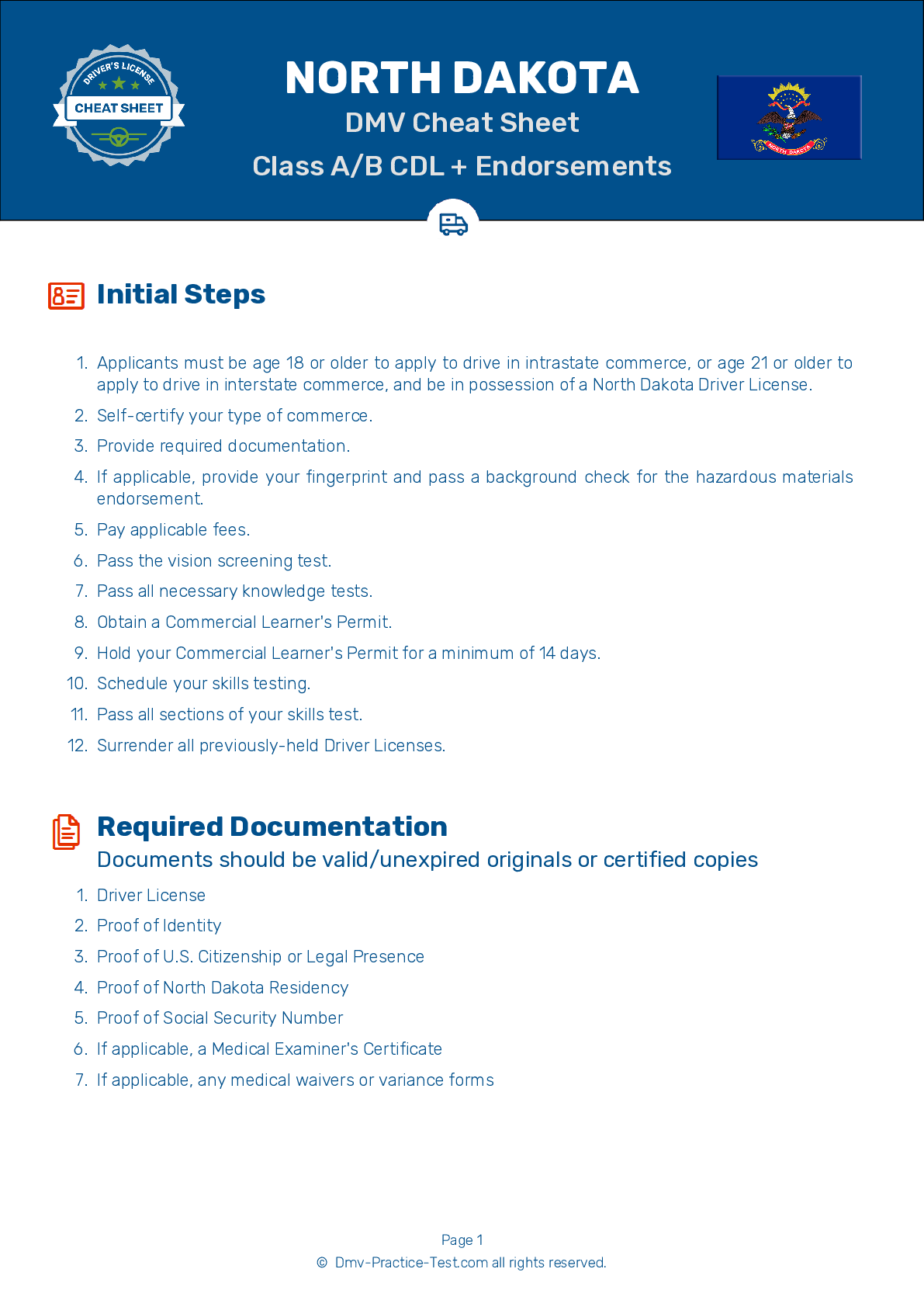
To acquire a CDL Hazmat endorsement in North Dakota, you must first have a CDL license. Then, pass the Hazardous Materials Endorsement Knowledge Test at a North Dakota Department of Transportation office. After passing, you'll need to complete a TSA background check. Once cleared, your Hazmat endorsement will be added to your CDL license.
To obtain a CDL Hazmat license, you must first have a valid Commercial Driver's License (CDL). You also need to be at least 21 years old. Additionally, you must pass the Hazardous Materials Endorsement Knowledge Test, and complete a TSA background check. U.S. citizenship or permanent legal residency is also required.
When applying for a CDL Hazmat endorsement, you must provide proof of U.S. citizenship or legal presence, such as a U.S. passport or birth certificate. You will also need your current CDL. Additionally, you must complete the TSA's Hazardous Materials Endorsement Threat Assessment Program, which includes fingerprinting and a background check.
Yes, there is a dedicated written test for the CDL Hazmat endorsement in North Dakota. This test focuses on the knowledge necessary to handle hazardous materials safely, including loading and unloading, use of placards, driving and parking rules, and emergency response procedures. It is required to pass this test to obtain the endorsement.
The written test for the CDL Hazmat endorsement covers a variety of subjects related to hazardous materials. These include identifying different types of hazardous materials, understanding shipping papers, knowing placarding rules, and understanding the rules for loading and unloading hazardous materials. It also covers emergency response procedures in case of a hazardous material incident.
Yes, there are extra charges involved in acquiring a CDL Hazmat endorsement. You'll need to pay for the TSA's Hazardous Materials Endorsement Threat Assessment Program, which costs about $86.50. Additionally, some states may charge a fee for the endorsement itself, which varies by state. Always check with your local DMV for the most accurate information.
Yes, obtaining a CDL Hazmat endorsement requires passing a background check and security clearance. This involves a review of your criminal history, immigration status, and mental health information. The Transportation Security Administration (TSA) conducts this check to ensure the safety and security of hazardous materials transportation.
Yes, specialized training is required for the CDL Hazmat endorsement. It involves passing a written test about transporting hazardous materials. This test covers topics such as loading and unloading hazardous materials, driving and parking rules, and emergency response procedures. Once you pass the test, you'll receive a certificate of training, which is mandatory to obtain the endorsement.
No, you cannot transport hazardous materials without a valid CDL Hazmat endorsement in the United States. This endorsement is required by federal regulations to ensure the safe transportation of hazardous materials. Driving without this endorsement when required can result in serious penalties, including fines and suspension of your commercial driver's license.
You can add a Hazmat endorsement to your current CDL. It doesn't require a new CDL application. However, you'll need to pass a written test and undergo a TSA background check. Once you pass these, the Hazmat endorsement will be added to your existing CDL license.