Tank #1
Tank Endorsement Test | Iowa 2026 #1
Train for FREE with our Iowa tank endorsement practice test online. The official exam test consists of several obligatory parts, with all of them checking your knowledge of different blocks of road rules. If you need to obtain a IA tank license in 2026, practice as much as possible. Free sample tests published on our website will help you check and improve your knowledge and boost your grades. Please bear in mind that DMV requirements for issuing a CDL tank vehicle endorsement may vary from state to state.
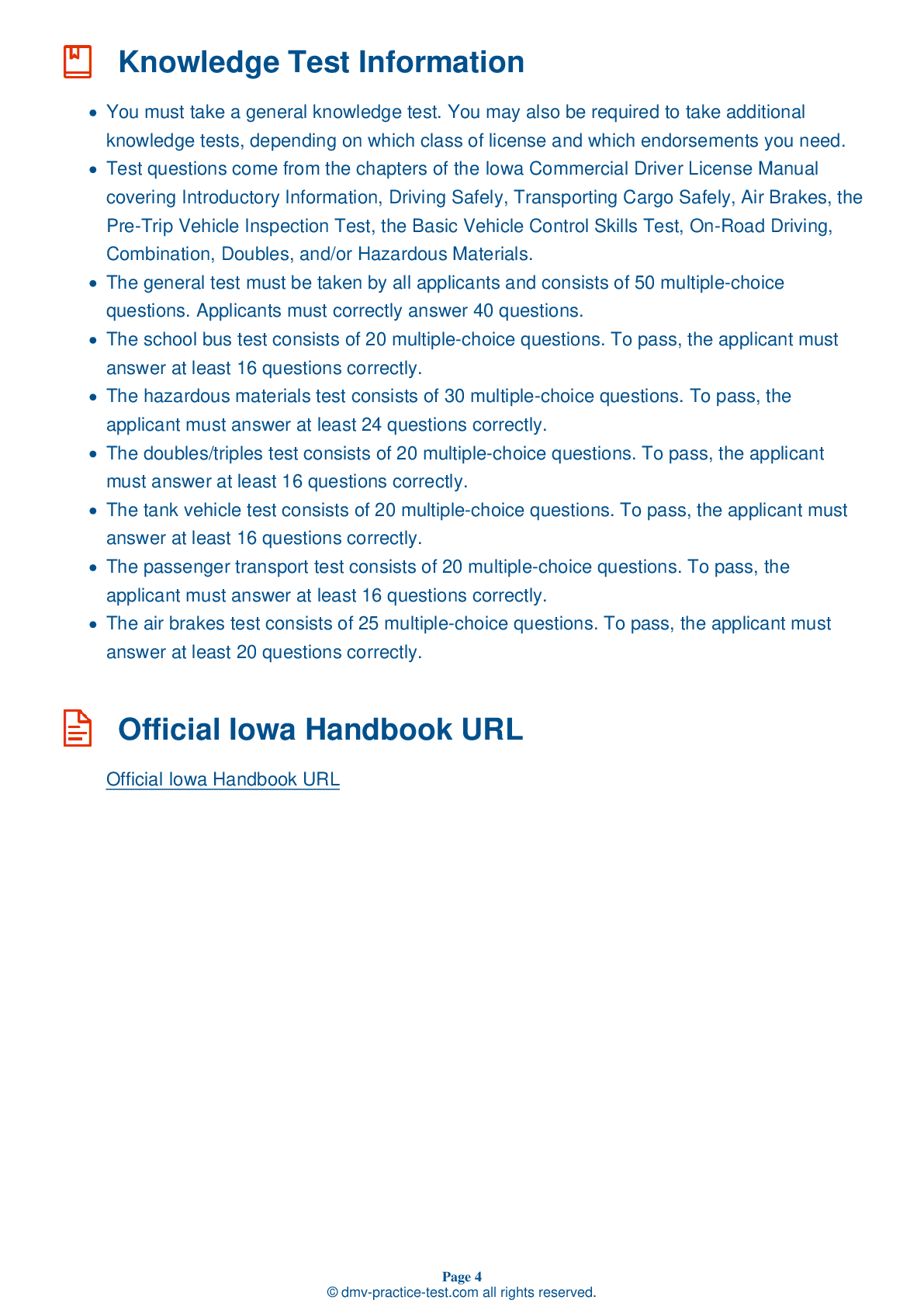
20
16
20
1 . When it is difficult to see other vehicles, such as at dawn or dusk, you should:
When driving at dawn, at dusk, or in inclement weather, you should use your headlights on their low beam setting to increase your visibility.
2 . If the letter “G” appears in Column 1 of a hazardous materials shipping paper, the shipping paper must also include:
A "G" in Column 1 of a hazardous materials shipping paper indicates that the description in Column 2 is the generic name for a material. A generic shipping name must be accompanied by a technical name.
3 . Within 10 minutes of stopping on the side of the road, you must:
If you must stop on the side of the road, you must place the appropriate emergency warning devices within 10 minutes of stopping.
4 . Shipping papers should be:
When transporting hazardous materials, shipping papers should be kept in a pouch in the driver's side door, or in another location where the driver is able to easily reach them while their seat belt is fastened. The papers must be easily visible to anyone who is entering the cab.
5 . How many daily hours of sleep does an adult need to maintain alertness?
Being properly rested is essential to the safe operation of a CMV. To maintain alertness, most people need eight to nine hours of sleep per night.
6 . Which of the following is not a sign of bad brakes?
When inspecting your brakes, you should check for cracked drums; shoes or pads covered in oil, grease, or brake fluid; and shoes that are missing, broken, or worn dangerously thin.
7 . Which of the following is not an example of a distracted person who should concern motorists?
You should be cautious when you are near people who are not paying attention to the road. Drivers and pedestrians who are talking to someone may be distracted by the conversation and not fully paying attention to the road. Workers on or near the road may not be paying attention to traffic because they are focused on their work, and can themselves also be a distraction to drivers.
Search the best driving school in your neighbourhood
2026 Iowa | Frequently Asked Questions
To secure a CDL Bus endorsement in Iowa, you must first hold a valid Commercial Driver's License (CDL). You then need to pass the Passenger Transport Test, undergo a physical examination, and complete a skills test in the type of vehicle you'll be driving. Finally, you must pass a background check as mandated by Federal Motor Carrier Safety Administration.
To obtain a CDL Bus license, you must first have a valid driver's license. Then, pass the CDL general knowledge test, and the passenger transport test. You must also pass a physical examination and a skills test in the type of bus you will be driving. Finally, submit to a background check as required by the Federal Motor Carrier Safety Administration.
Yes, specific training is necessary for a CDL Bus endorsement. You must complete a commercial driver's education course, pass the general knowledge and passenger transport written tests, and successfully complete a skills test in the type of bus you'll be driving. Some states also require applicants to have a certain amount of driving experience.
CDL Bus licenses are classified into three main categories: Class A, B, and C. Class A is for vehicles with a combined weight over 26,001 lbs where the vehicle being towed is over 10,000 lbs. Class B is for single vehicles over 26,001 lbs not towing a vehicle over 10,000 lbs. Class C is for vehicles carrying 16 or more passengers including the driver or hazardous materials.
No, you cannot use your personal vehicle for the CDL Bus driving test. The test must be taken in the same type of vehicle for which you are trying to get licensed. This means you will need to take the test in a commercial bus similar to the one you will be driving professionally.
During the CDL Bus driving test, you'll be evaluated on several skills. These include pre-trip vehicle inspection, basic vehicle control (backing, turning, stopping), and on-road driving (including highway, city, and residential driving). You'll also be tested on specific bus maneuvers such as loading and unloading passengers, bus stop procedures, and emergency exit procedures.
Yes, there are additional medical prerequisites for a CDL Bus endorsement. You must pass a Department of Transportation (DOT) physical exam every 24 months. The exam assesses hearing, vision, blood pressure, and checks for conditions like diabetes or epilepsy that could affect your ability to safely operate a bus.
No, it's not permissible to transport passengers without a valid CDL Bus endorsement in Iowa. It's a requirement by law for drivers who operate a vehicle designed to carry 16 or more passengers, including the driver. Driving such a vehicle without the proper endorsement could result in serious legal consequences, including fines and suspension of your driving privileges.
Yes, the CDL Bus endorsement can be added to your existing CDL in Iowa. You don't need to apply for a new license, but you must pass the Passenger Transport test. Once you pass, the endorsement will be added to your current CDL. However, you may need to renew your license if it's close to its expiration date.
Yes, drivers with a CDL Bus endorsement must comply with federal and state regulations. These include maintaining a logbook of hours driven, undergoing regular medical examinations, and adhering to restrictions on alcohol consumption. Also, some states may have additional restrictions such as age limits and mandatory rest periods between driving shifts.