Knowledge Test Class A #1
Class A Driving Test | Hawaii 2026 #1 Page 6 of 7
Train for FREE online with our Hawaii class A license test. The official exam test consists of several obligatory parts, with all of them checking your knowledge of different blocks of road rules. If you need to obtain a HI CDL class A permit in 2026, practice as much as possible. Free sample tests published on our website will help you check and improve your knowledge and boost your grades. Please bear in mind that CDL class A requirements may vary from state to state.
50
40
20
36 . On a slippery road, a driver should:
Under slippery conditions, you should drive slowly and smoothly. Make turns as gently as possible and do not pass other vehicles unless you have to.
37 . If your brakes fail when traveling downhill, decide what to do as quickly as possible because:
However you choose to deal with a brake failure on a downhill slope, it is important that you make your decision as quickly as possible. The longer you wait to act, the faster your vehicle will be moving, and the harder it will become to stop.
38 . Slow down and be extra careful:
Slow down and be especially careful when driving in and around work zones, in places where the pavement drops off sharply at the edge of the road, when foreign objects are present on the road, and on freeway on- and off-ramps.
39 . When parked on a flat surface, you should:
When parking on a level surface, you should use wheel chocks. If the vehicle is not equipped with spring brakes, this is essential to prevent the trailer from moving.
40 . During an applied leakage test, what is the maximum leakage rate that is safe for a single vehicle with air brakes?
It is important to know the maximum air loss rate that is safe for your specific vehicle. A single vehicle with air brakes should have a leakage rate no higher than 3 psi in a minute during an applied leakage test.
41 . A tread depth of ____ should be in every major groove of a front tire.
For safe operation, a commercial motor vehicle needs a tread depth of 4/32 of an inch in every major groove on the front tires, and a tread depth of 2/32 of an inch on other tires.
42 . Bracing is used to:
Blocking and bracing are used to prevent cargo from shifting in transit. Blocking is used in the front, in the back, and on the sides of a piece of cargo to prevent movement. Bracing prevents movement by reaching from the upper portion of a piece of cargo to the floor and sides of the cargo compartment.
2026 Hawaii | Frequently Asked Questions
A Commercial Driver's License (CDL) Class B in Hawaii allows the holder to operate single vehicles with a Gross Vehicle Weight Rating (GVWR) of 26,001 pounds or more, or any such vehicle towing another not exceeding 10,000 pounds GVWR. This includes buses, farm labor vehicles, and any combination of vehicles not defined in Class A or Class C.
A Class B CDL license in Hawaii allows the holder to operate single vehicles with a Gross Vehicle Weight Rating (GVWR) of 26,001 pounds or more, and any such vehicle towing another not exceeding 10,000 pounds. Examples include straight trucks, large buses, segmented buses, box trucks, dump trucks with small trailers, and tractor-trailers.
To acquire a Class B CDL license in Hawaii, applicants must be at least 21 years old (18 for intrastate driving), possess a valid Hawaii driver's license, pass a vision test, and successfully complete both a knowledge test and a skills test. Applicants must also provide proof of U.S. citizenship or lawful permanent residency and meet medical requirements.
To qualify for a Class B CDL license in Hawaii, you must be at least 21 years old. This age requirement is standard across the United States and is set by the Federal Motor Carrier Safety Administration. It's important to meet this age requirement before beginning the process of obtaining a Class B CDL.
While not always required, specific endorsements may be necessary for a Class B CDL license in Hawaii depending on the type of vehicle you plan to operate or the cargo you will be transporting. Examples include a passenger endorsement for buses, a school bus endorsement for school buses, or a hazardous materials endorsement for transporting hazardous materials.
The Class B CDL skills assessment in Hawaii includes three parts: a pre-trip vehicle inspection to test your ability to assess the safe operation of the vehicle, a basic control skills test to evaluate your handling of the vehicle, and an on-road driving test to assess your ability to safely operate the vehicle in various traffic situations.
Yes, Class B CDL license holders in Hawaii are limited to driving single vehicles with a gross vehicle weight rating of 26,001 or more pounds, or any such vehicle towing a vehicle not exceeding 10,000 pounds. They are not allowed to drive a combination of vehicles (like a tractor-trailer) unless they hold a Class A CDL.
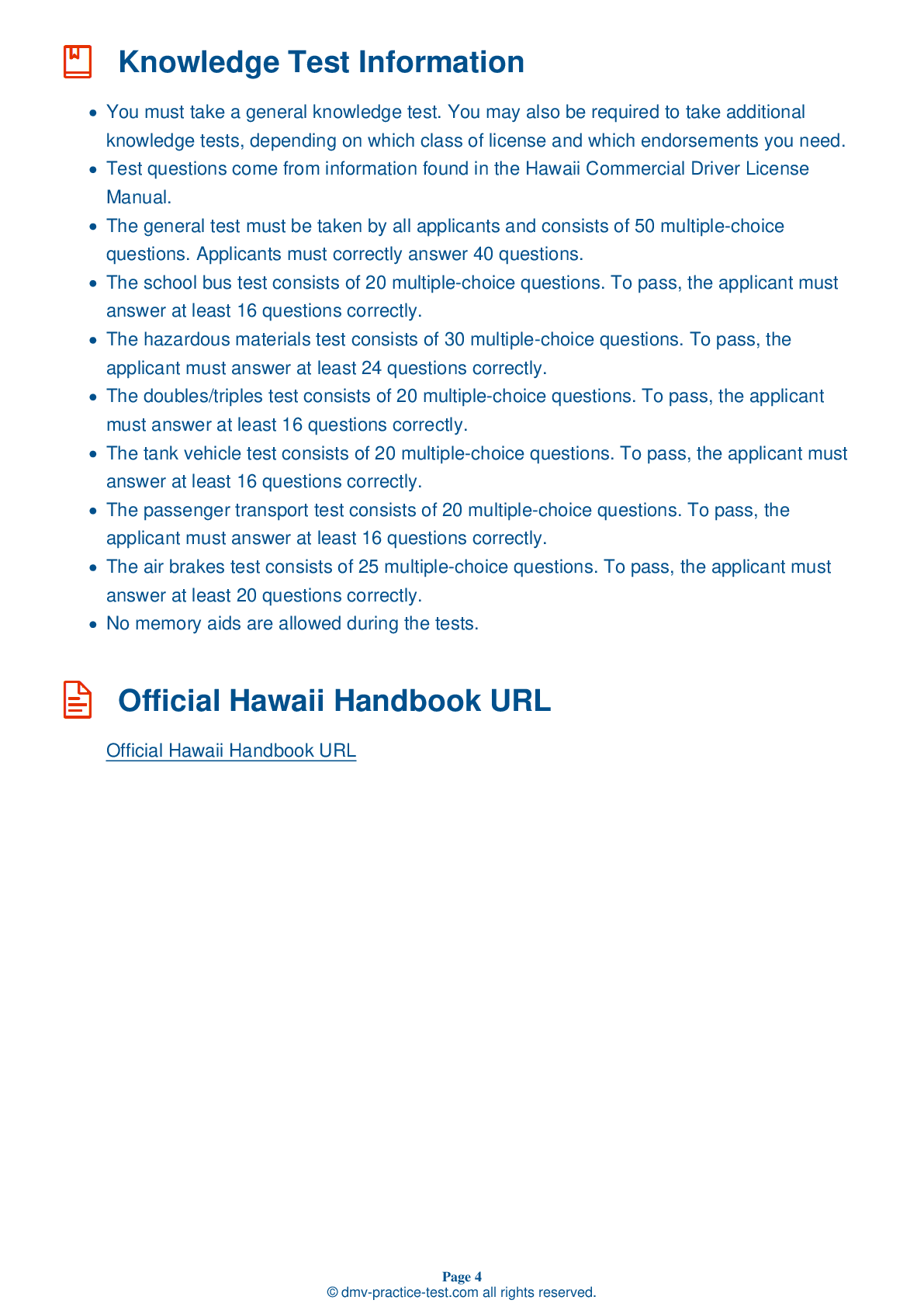
In Hawaii, the written Class B Commercial Driver's License (CDL) test is typically administered in English. However, some testing centers may offer the test in other languages. It's advised to contact your local testing center directly to inquire about language options. Remember, Federal regulations require all CDL holders to read and speak English proficiently.
Yes, you can request accommodations for the Class B CDL written exam in Hawaii if you have a disability. The specific process and types of accommodations available may vary, so it's best to contact the Hawaii Department of Transportation directly to discuss your needs and learn about the available options.
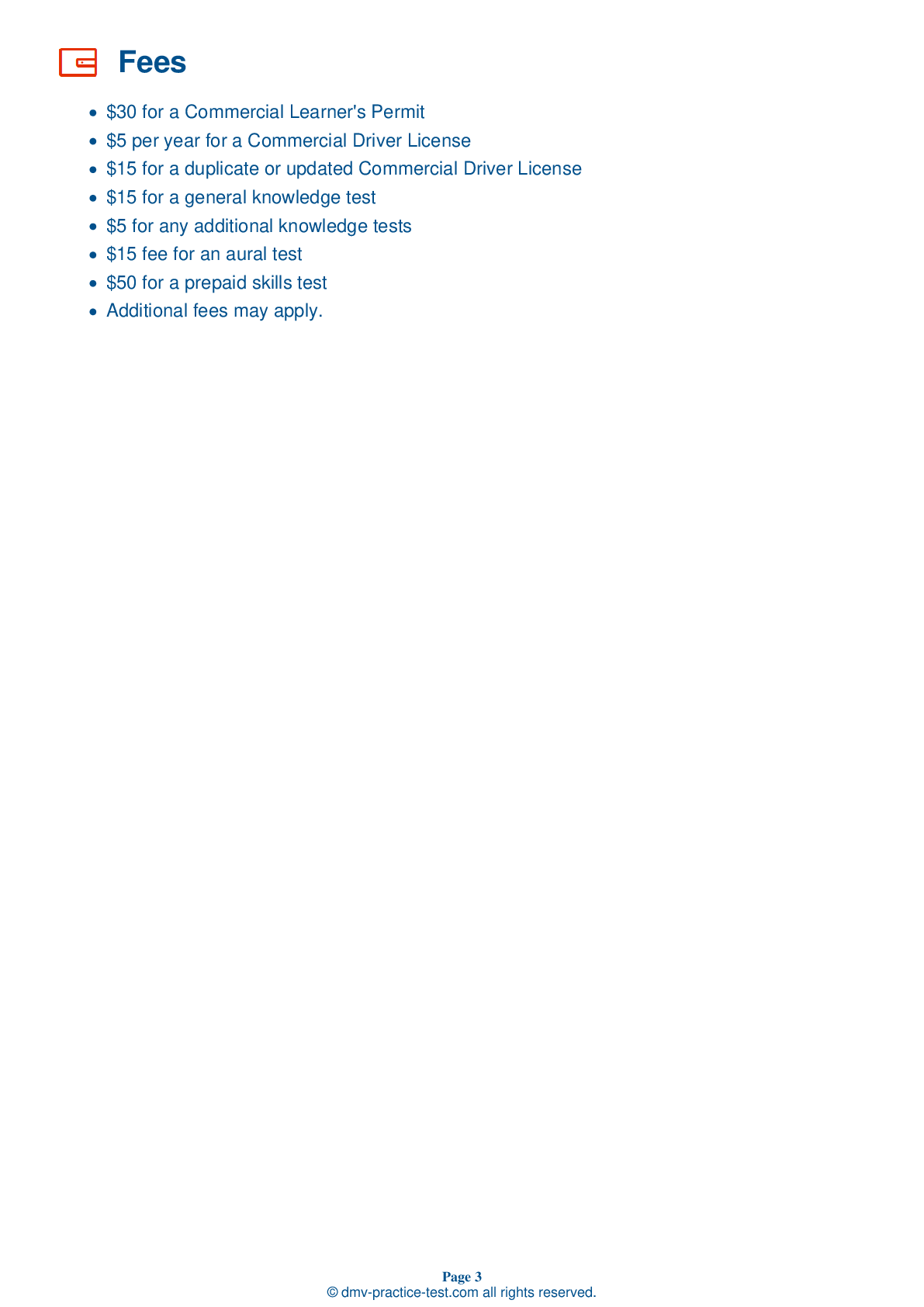
Yes, if you don't pass the Class B CDL written test in Hawaii, you can retake it. You must wait a minimum of one week before retesting. There may be a retesting fee, and if you fail three times, you'll need to start the application process over again. Always check with your local DMV for specific rules and regulations.