Knowledge Test Class A #1
Class A Driving Test | Delaware 2026 #1 Page 7 of 7
Train for FREE online with our Delaware class A license test. The official exam test consists of several obligatory parts, with all of them checking your knowledge of different blocks of road rules. If you need to obtain a DE CDL class A permit in 2026, practice as much as possible. Free sample tests published on our website will help you check and improve your knowledge and boost your grades. Please bear in mind that CDL class A requirements may vary from state to state.
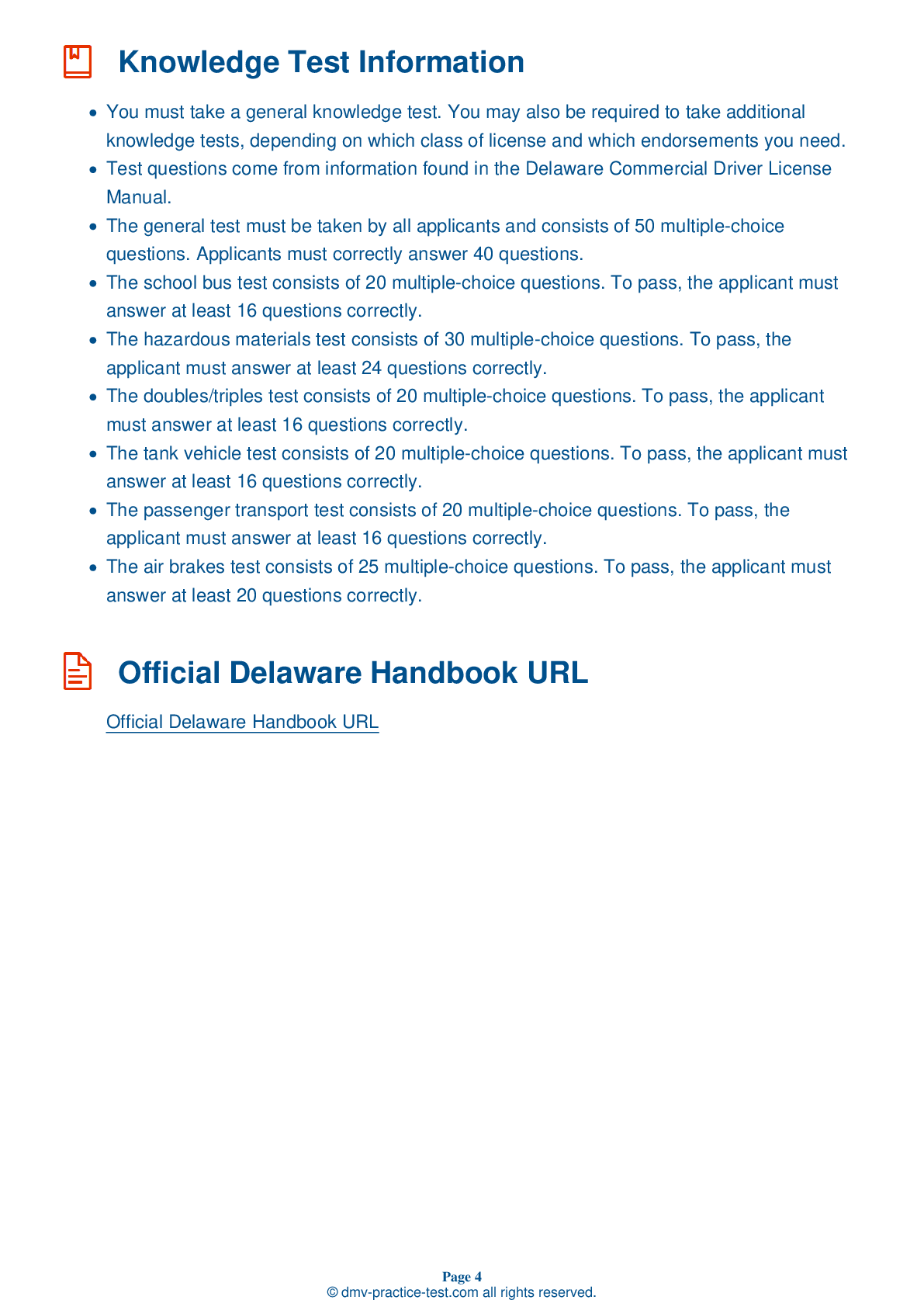
50
40
20
43 . How should you test the low pressure warning signal?
Uncouple and recouple all glad hands.
It is essential that your low pressure warning light functions properly. After allowing the system to charge, you can test the warning signal by rapidly applying and releasing the brake pedal. This will release air from the braking system and the warning signal should come on when pressure drops to a dangerous level.
44 . Maintaining a cushion of space between your vehicle and the vehicle ahead is:
For safe driving, it is essential that you maintain cushions of space on all sides of your vehicle. This helps to ensure that you will have time to take appropriate action if a problem arises.
45 . A distracted driver:
Distracted drivers perceive hazards on the road more slowly than drivers who are focused, or they do not perceive hazards at all.
46 . When inspecting cargo, the driver should ensure all of the following, except:
That the cargo is heavier at the top than the bottom.
When inspecting cargo, a driver must ensure that the cargo is balanced and properly secured. To reduce the risk of a rollover, the weight of a load of cargo should be kept as low as possible. A trailer should not be overloaded.
47 . When pulled off on the side of the road:
If you must stop on the side of the road, make sure to use your four-way emergency flashers. This is particularly important at night.
48 . When passing a row of parked vehicles, a driver should:
You should be cautious when passing parked vehicles. A person may step out of a parked vehicle or out from between parked vehicles without looking for oncoming traffic. A driver may begin moving their vehicle before realizing you are there.
49 . A cardboard box on the roadway:
Almost any foreign object on the road poses some potential danger. For example, even something as seemingly harmless as a cardboard box could contain a hard or heavy object that could damage your vehicle.
50 . When driving on the expressway during the skills test, you should:
Drive above the posted speed limit.
During the on-road driving skills test, you may be asked to drive on an expressway. Make sure you maintain proper lane positioning, vehicle spacing, and vehicle speed. Continue to thoroughly check traffic in all directions while on the expressway.
2026 Delaware | Frequently Asked Questions
To acquire a CDL Tank endorsement in Delaware, you must first have a Commercial Driver's License (CDL). Next, you'll need to pass a written knowledge test specific to tank vehicles. The test covers topics like inspecting tank vehicles, driving tank vehicles, and safe driving rules. The Delaware DMV offers study materials to help you prepare for the test.
To obtain a CDL Tank license, it's essential to already have a Commercial Driver's License (CDL). Then, you must pass a written knowledge test specific to tank vehicles. The test covers areas such as inspecting tank vehicles, driving them, and understanding safe driving rules. Preparation materials are available through the Delaware DMV to aid in your study for the test.
While specific training or experience is not mandatory for a CDL Tank endorsement in Delaware, it's highly recommended. Having practical experience or training can help you pass the specific written knowledge test, which covers areas such as inspecting and driving tank vehicles, and understanding safe driving rules. However, the requirement is passing the test, not prior training or experience.
Yes, an additional written knowledge test is required to obtain a CDL Tank endorsement in Delaware. This test focuses on specific areas related to tank vehicles, including inspection, driving, and safe driving rules. It's recommended to study the provided materials and guides from the Delaware DMV to prepare for this test.
The written test for the CDL Tank endorsement in Delaware covers subjects such as tanker truck inspection, proper loading and unloading procedures, safe driving techniques for transporting liquids or gases, and emergency response protocols. It also includes questions on understanding placards and hazardous materials regulations.
The CDL Tank endorsement assessment doesn't include a skills or maneuvers test. It only requires a written knowledge test. The test covers subjects like inspecting tank vehicles, safe driving rules, and driving tank vehicles. It's crucial to understand the high center of gravity in tank vehicles and how to handle surge, among other things.
Yes, there are some limitations. Drivers with a CDL Tank endorsement are only allowed to operate commercial motor vehicles designed to transport any liquid or gaseous materials within a tank. Additionally, the tank must have a rated capacity of 1,000 gallons or more. Also, certain hazardous materials may require additional endorsements.
No, transporting liquid or gas materials without a valid CDL Tank endorsement is illegal in Delaware. This endorsement is required to ensure that drivers have the necessary skills and knowledge to handle such materials safely. Violating this rule could result in serious penalties, including fines and suspension of the driver's commercial driving license.
Yes, a CDL Tank endorsement can be added to your existing CDL. You don't need to apply for a new license. However, you will need to pass the Tank endorsement written test. Upon passing, the Tank endorsement will be added to your current CDL, and you can then legally operate tank vehicles.
Yes, handling hazardous materials requires a separate Hazardous Materials (HazMat) endorsement in addition to the CDL Tank endorsement. Applicants must pass a written test, undergo a TSA background check, and be fingerprinted. Furthermore, carriers must follow specific federal and state regulations for packaging, labeling, and transporting hazardous materials.