Knowledge Test Class A #2
Class A Driving Test | Connecticut 2026 #2 Page 6 of 7
Train for FREE online with our Connecticut class A license test. The official exam test consists of several obligatory parts, with all of them checking your knowledge of different blocks of road rules. If you need to obtain a CT CDL class A permit in 2026, practice as much as possible. Free sample tests published on our website will help you check and improve your knowledge and boost your grades. Please bear in mind that CDL class A requirements may vary from state to state.
50
40
20
36 . Before a vehicle with dual air brakes is driven, pressure of at least ____ should be built up in both braking systems.
100 psi
Before driving a vehicle with a dual air brake system, allow time for the air compressor to build up pressure of at least 100 psi in both the primary and secondary systems.
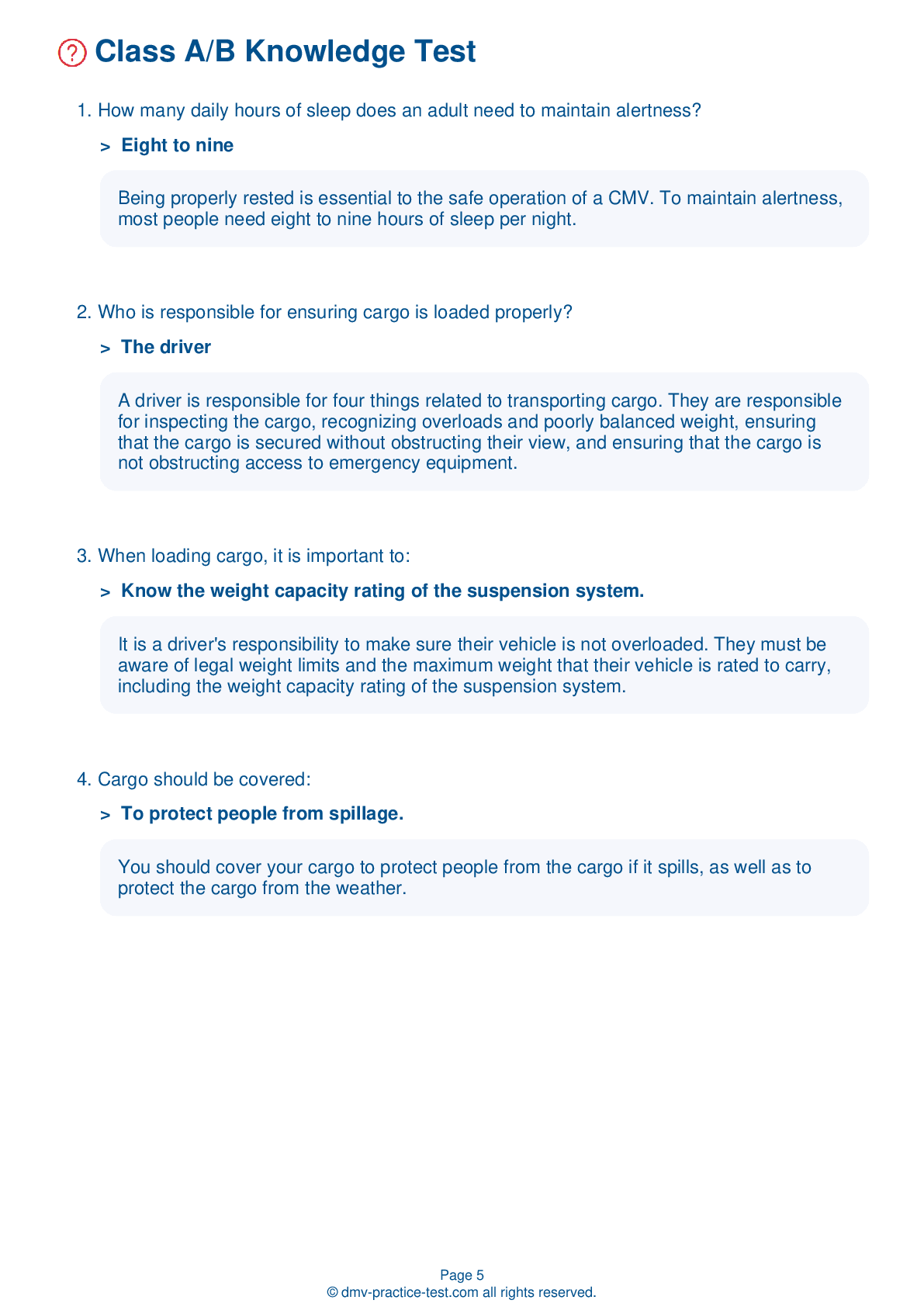
37 . How many daily hours of sleep does an adult need to maintain alertness?
Four to five
Being properly rested is essential to the safe operation of a CMV. To maintain alertness, most people need eight to nine hours of sleep per night.
38 . When traveling down a long downgrade, you should brake by:
Never using the brakes.
On a downgrade, you should use the braking effect of your engine as the principal way of controlling your speed. Save your brakes for additional slowing or stopping that may be required by road or traffic conditions.
39 . What is the purpose of a vehicle inspection report?
It provides a plan for the next five trips.
A vehicle inspection report allows a driver to inform the motor carrier of issues that could affect the safe operation of a vehicle. If required, the driver should fill out a vehicle inspection report after every day of driving. They should make note of any issues that could affect the safety of the vehicle or that could lead to a mechanical breakdown.
40 . If another driver is following you too closely, you should do all of the following, except:
Avoid relying on tricks to help others pass.
If you are being followed too closely, you should increase your following distance, avoid making quick moves, and avoid relying on tricks (such as flashing your lights) to help other drivers pass. Speeding up may only increase the danger by causing the tailgater to continue tailgating you at a higher speed.
41 . When transporting cargo, drivers must check the securement of the cargo every:
The securement of cargo must be checked before beginning a trip, within the first 50 miles of a trip, and then again every three hours or 150 miles thereafter.
42 . The brake pedal is part of which braking system?
The auxiliary brake system
The service brake system applies and releases the brakes when a driver presses the brake pedal while driving normally.
2026 Connecticut | Frequently Asked Questions
To secure a CDL Bus endorsement in Connecticut, you must first have a Commercial Driver's License (CDL). Then, pass the Passenger Endorsement Knowledge Test and the School Bus Endorsement Knowledge Test. Following this, complete a state and federal background check. Lastly, pass the Skills Test in a school bus of the appropriate class. Training may be required before testing.
To obtain a CDL Bus license in Connecticut, you need to have a valid driver's license, pass the CDL general knowledge test, and the Passenger Transport test. You must also pass a physical examination, provide proof of residency and identity, and pass a driving skills test in the type of vehicle you wish to be licensed for.
Yes, specific training is necessary for a CDL Bus endorsement in Connecticut. You must complete a bus-specific training program, which includes classroom instruction and behind-the-wheel training. The program covers topics such as passenger loading and unloading, emergency procedures, and bus inspection. After training, you must pass both knowledge and skills tests.
CDL Bus licenses in Connecticut fall into three classifications: Class A, B, and C. Class A is for combination vehicles like tractor-trailers. Class B is for single or combination vehicles like buses, dump trucks, or tow trucks. Class C is for transporting 16 or more passengers or hazardous materials. Each class requires specific tests and may require additional endorsements.
No, you cannot use your personal vehicle for the CDL Bus driving test in Connecticut. The vehicle used for testing should represent the type and class of bus you plan to drive. It must meet all safety standards and be properly registered and insured. This ensures you demonstrate appropriate skills for the specific type of commercial vehicle.
During the CDL Bus driving test in Connecticut, you'll be evaluated on skills such as vehicle inspection, controlling the vehicle, shifting gears, parallel parking, and making proper turns. Additionally, you'll be assessed on interacting with traffic, managing speed and space, and handling emergencies or hazardous conditions.
Yes, to obtain a CDL Bus endorsement in Connecticut, applicants must pass a Department of Transportation (DOT) physical exam every two years. The exam assesses vision, hearing, blood pressure, and overall physical health. Additionally, you must be free from any condition that could affect your ability to safely operate a vehicle, such as epilepsy or severe heart conditions.
No, it's not permissible to transport passengers without a valid CDL Bus endorsement in Connecticut. This endorsement is required for drivers who wish to operate a vehicle designed to carry 16 or more passengers, including the driver. Driving such a vehicle without the appropriate endorsement can result in serious penalties, including fines and suspension of your license.
In Connecticut, the CDL Bus endorsement can be added to your existing CDL. You don't need to apply for a new license. However, you'll need to pass the Passenger Endorsement Knowledge Test and the Skills Test in a vehicle representative of the class of bus you wish to drive. It's important to check with the DMV for specific requirements.
Yes, there are limitations. Drivers with a CDL Bus endorsement in Connecticut must adhere to the Federal Motor Carrier Safety Regulations. They must not have any serious traffic violations, cannot drive under the influence of drugs or alcohol, and must maintain a clean driving record. Additionally, they must pass a physical exam every two years to ensure they're medically fit to operate a bus.