Knowledge Test Class A #1
Class A Driving Test | Colorado 2026 #1 Page 2 of 7
Train for FREE online with our Colorado class A license test. The official exam test consists of several obligatory parts, with all of them checking your knowledge of different blocks of road rules. If you need to obtain a CO CDL class A permit in 2026, practice as much as possible. Free sample tests published on our website will help you check and improve your knowledge and boost your grades. Please bear in mind that CDL class A requirements may vary from state to state.
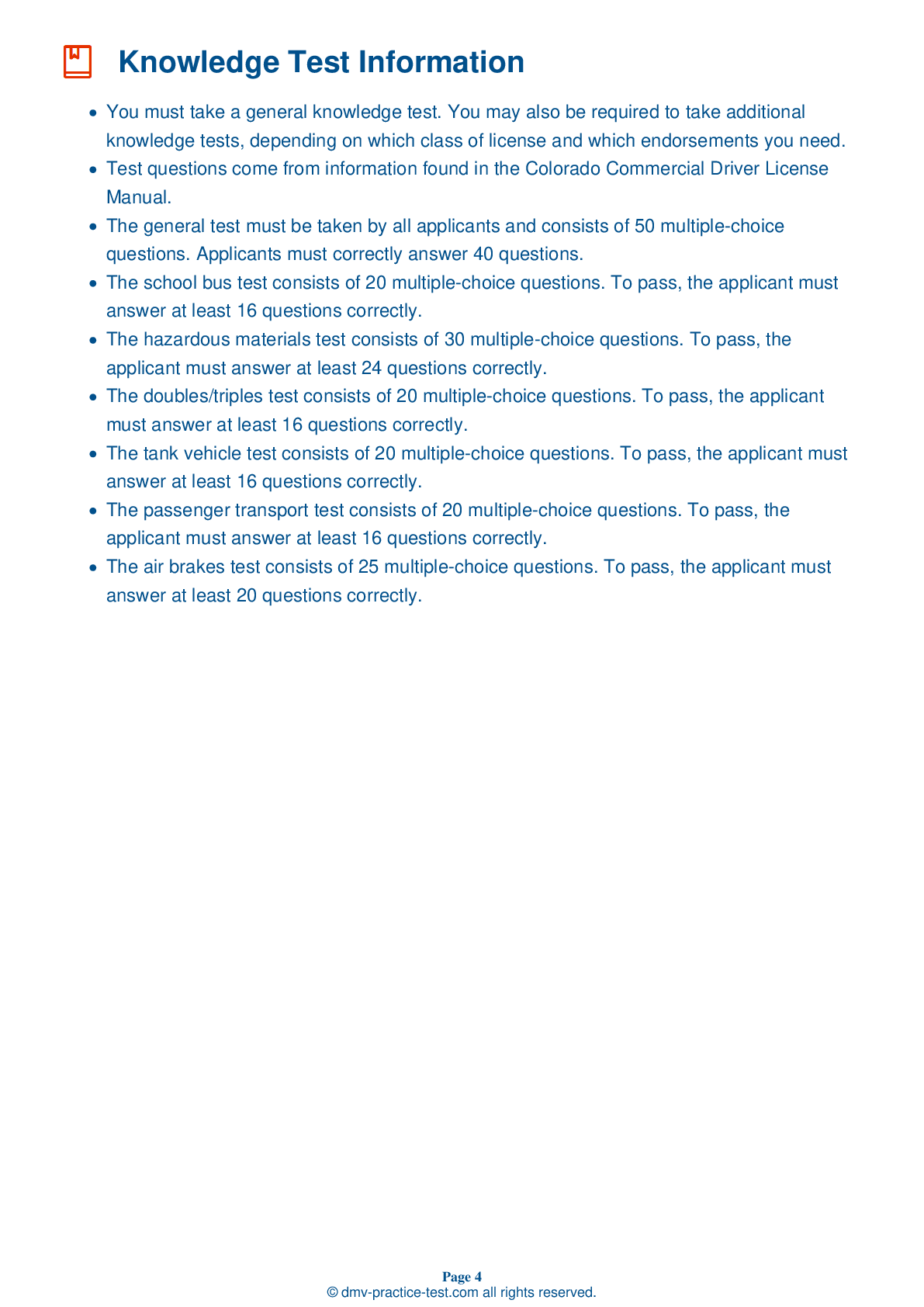
50
40
20
8 . While driving a vehicle, if an unusual noise or feeling occurs, the driver should:
Drive on the shoulder.
If you see, hear, smell, or feel anything that could indicate trouble while you are driving, you should stop and inspect the source of the unusual occurrence.
9 . If a person operates in both excepted and non-excepted intrastate commerce, which type of license should the driver select?
Traditional
To operate in both excepted intrastate commerce and non-excepted intrastate commerce, you must choose a non-excepted intrastate commerce license.
10 . If transporting 30 feet of cargo on a flatbed trailer, you should use a minimum of ____ to restrain the cargo.
Four tie-downs
When transporting cargo on a flatbed trailer, you should use at least one tie-down for every 10 feet of cargo. Any cargo, no matter how small, should be restrained by a minimum of two tie-downs.
11 . During a static leakage test, the maximum leakage rate for a single vehicle with air brakes is ____ in one minute.
4 psi
When performing a static leakage test on a single vehicle with air brakes, the leakage rate should be no more than 2 psi in a minute. If air leaks from the air brake system at a quicker rate, the vehicle should not be driven because something likely needs to be repaired.
12 . When driving, it is important to:
Look to the front, sides, and rear of your vehicle.
For safe driving, it is essential that you are aware of what is happening on all sides of your vehicle. In addition to watching the road ahead, you should frequently check your mirrors to monitor the road to the sides and to the rear of your vehicle.
13 . If a vehicle gets stuck on a railroad track, the driver should:
Wait in the vehicle for a law enforcement officer to arrive.
If your vehicle gets stuck on railroad tracks, immediately exit the vehicle and get away from the tracks. Check signs or signal housing at the crossing for emergency contact information. Call the emergency contact or call 911.
14 . Dollies equipped with ABS are required to have malfunction lamps located where?
On the top
A dolly equipped with an Anti-Lock Braking System (ABS) is required to have a yellow malfunction lamp located on its left side.
2026 Colorado | Frequently Asked Questions
To secure a CDL Doubles/Triples endorsement in Colorado, you must already hold a valid CDL. You'll need to pass a knowledge test on handling large trucks with multiple trailers. After passing, the endorsement will be added to your CDL. Remember, this endorsement does not cover the operation of motorcycles or school buses.
To obtain a Colorado CDL Doubles/Triples license, you should first have a valid Colorado CDL. Then, you'll need to pass the Doubles and Triples endorsement test. This test covers topics like coupling and uncoupling, inspecting doubles and triples, and handling. After passing the test, the endorsement will be added to your CDL.
While Colorado doesn't specifically require specialized training for a CDL Doubles/Triples endorsement, it's highly recommended. Training can ensure you're prepared for the knowledge test and safe operation of these vehicles. Experience driving a single trailer truck may also be beneficial, but isn't required. The key requirement is passing the endorsement knowledge test.
Yes, to obtain a CDL Doubles/Triples endorsement in Colorado, you must pass a written knowledge test. This exam focuses on the safe operation and handling of large trucks with multiple trailers. It's important to study thoroughly, using resources like the Colorado CDL Handbook, to ensure success on this test.
For the CDL Doubles/Triples endorsement in Colorado, you're not required to perform a skills or road test. The endorsement solely requires passing a written knowledge test. This test covers topics like coupling and uncoupling, inspecting doubles and triples, and managing the vehicles on the road. Practical skills are important for safe driving but aren't formally tested for this endorsement.
No, it is not permissible to operate double or triple trailers in Colorado without a valid CDL Doubles/Triples endorsement. This endorsement is necessary to ensure that drivers have the specialized knowledge and skills required to safely operate such vehicles. Driving without the proper endorsement can result in legal penalties.
In Colorado, you can add the CDL Doubles/Triples endorsement to your existing commercial driver's license. You don't need to initiate a new application for a separate license. However, you must pass the written knowledge test specific to doubles/triples operation. After passing, the endorsement is added to your current CDL.
Yes, even with a CDL Doubles/Triples endorsement, Colorado drivers must adhere to specific rules. These include a maximum trailer length of 28.5 feet for each unit in a set of doubles, and the total weight of all units combined cannot exceed 80,000 lbs. Also, drivers must follow all federal and state transportation laws, including hours of service regulations.
In Colorado, the maximum legal weight for a vehicle, including double or triple trailers, is 80,000 pounds. The maximum length for a single trailer is 57 feet 4 inches. For double/triple trailers, the combined length should not exceed 100 feet. However, these restrictions may vary depending on road and bridge limits.
Yes, safety is paramount when operating double/triple trailers. Drivers must follow federal and state laws, including speed limits and hours of service regulations. They should also be well-versed in coupling and uncoupling procedures, inspecting the coupling system regularly. Additionally, they must understand the high rollover risk associated with these vehicles and ensure proper cargo distribution to prevent accidents.