Knowledge Test Class A #1
Class A Driving Test | California 2025 #1 Page 4 of 7
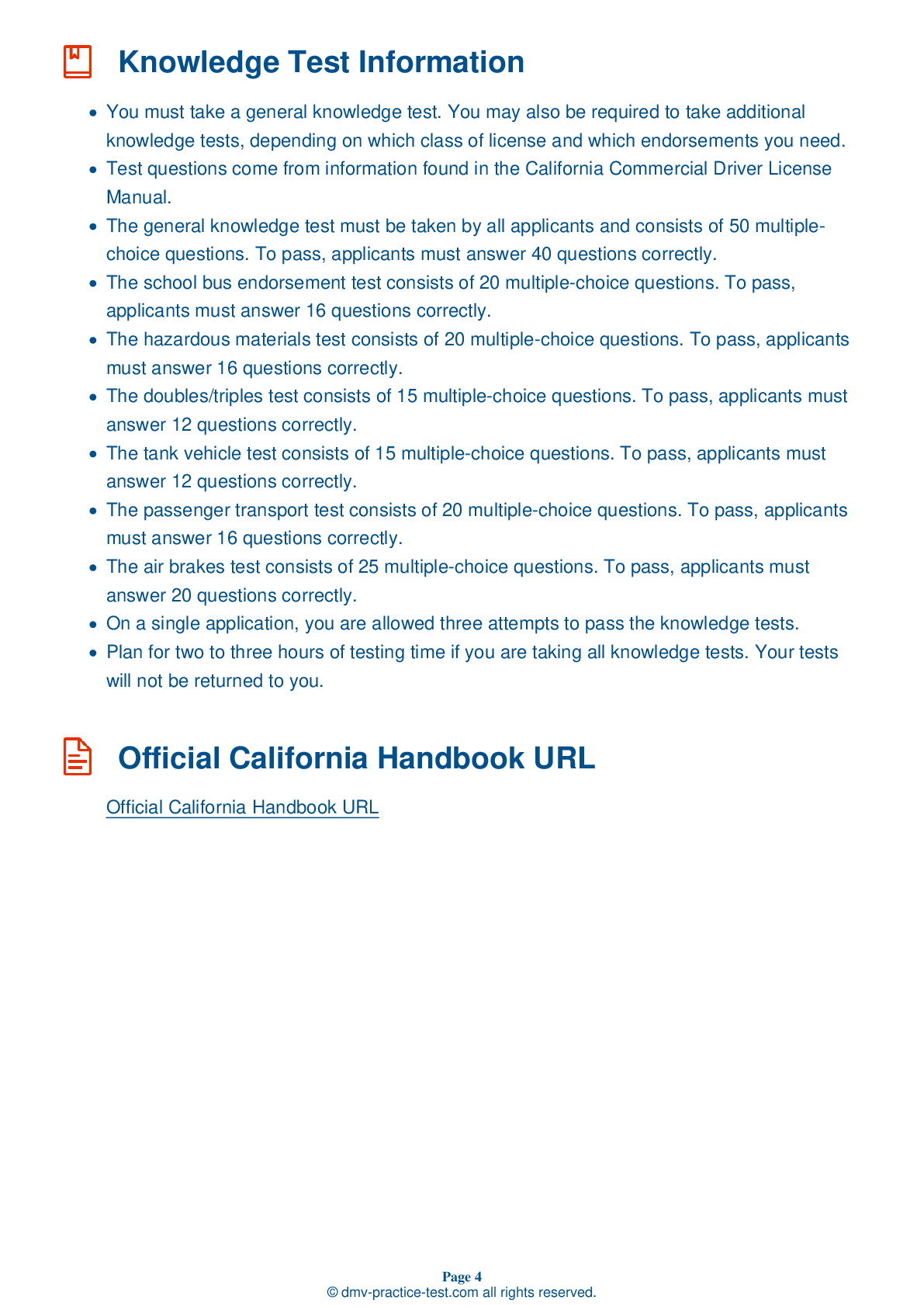
Train for FREE online with our California class A license test. The official exam test consists of several obligatory parts, with all of them checking your knowledge of different blocks of road rules. If you need to obtain a CA CDL class A permit in 2025, practice as much as possible. Free sample tests published on our website will help you check and improve your knowledge and boost your grades. Please bear in mind that CDL class A requirements may vary from state to state.
50
40
20
22 . Operating a commercial motor vehicle with a minimum blood alcohol content (BAC) of ____ is illegal.
In California, it is illegal to operate a commercial motor vehicle with a blood alcohol concentration (BAC) of 0.04 percent or higher. Driving under the influence of alcohol is both illegal and extremely dangerous.
23 . Before starting down a hill, be sure to:
Before starting down a hill, be sure to switch into a low gear. Gravity will increase your vehicle's speed as you travel downhill.
24 . In hot weather, spots on the pavement where tar is bleeding:
Tar in road pavement often rises to the surface of the road, or "bleeds," in very hot weather. Watch for such areas because they can be very slippery.
25 . In cool weather, as the temperature begins to rise and ice begins to melt:
As the temperature begins to rise and ice on the road begins to melt, the road surface will often become even more slippery. Water from the slight melting will sit on top of the ice, decreasing the available traction even more. Always decrease your speed and drive with caution when traveling on slippery surfaces.
26 . The leakage rate for a single vehicle with air brakes should be no more than ____ in one minute during a static leakage test.
When performing a static leakage test on a single vehicle with air brakes, the leakage rate should be no more than 2 psi in a minute. If the air leaks from the air brake system at a quicker rate, the vehicle should not be driven because something likely needs to be repaired.
27 . When an S-cam turns inside a brake drum, the S-cam:
When a brake pedal is pressed and the S-cam is turned, the S-cam presses the brake shoes against the inside of the brake drum. This causes friction and will cause the vehicle to slow.
28 . To avoid a hazard, you:
Stopping is not always the best way to avoid a hazard. If there is not enough space for you to stop to avoid coming into contact with the hazard, swerving out of the way may be your safest option.
2025 California | Frequently Asked Questions
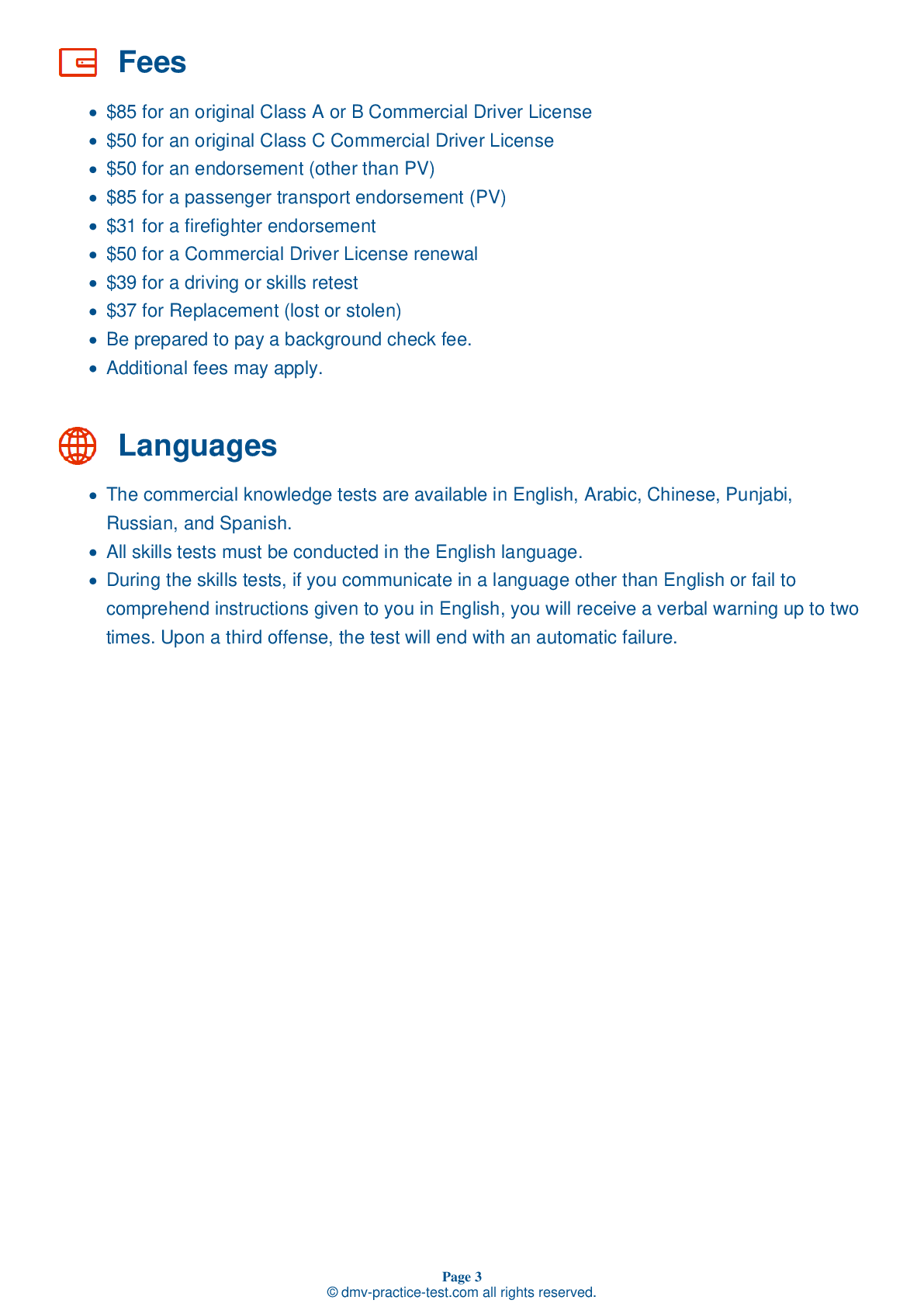
A CDL Class B license in California allows drivers to operate single vehicles with a gross vehicle weight rating (GVWR) of 26,001 pounds or more, or tow a vehicle not heavier than 10,000 pounds. This includes buses, farm labor vehicles, and any vehicle towing a vehicle not exceeding a GVWR of 10,000 pounds.
A Class B CDL license in California allows the operation of single vehicles with a gross vehicle weight rating (GVWR) of 26,001 pounds or more, or any such vehicle towing a vehicle not exceeding 10,000 pounds GVWR. This includes buses, dump trucks, delivery trucks, tow trucks, garbage trucks, and other similar vehicles.
To acquire a Class B CDL license in California, you must be at least 18 years old (21 for interstate driving), possess a valid non-commercial driver's license, pass a vision test, complete a medical examination, and successfully complete written and skills tests. You must also have a clean driving record and be able to demonstrate the ability to operate a Class B vehicle.
To qualify for a Class B CDL license in California, you must be at least 18 years old. However, you must be 21 years old or older to operate commercial vehicles across state lines or to transport hazardous materials or waste.
Yes, specific endorsements may be necessary for a Class B CDL license in California depending on the type of vehicle you plan to drive or cargo you plan to carry. For example, endorsements are required for passenger vehicles, school buses, tank vehicles, double/triple trailers, and for carrying hazardous materials.
The Class B CDL skills assessment in California includes three parts: pre-trip vehicle inspection, basic vehicle control, and on-road driving. You must show you can inspect your vehicle to ensure it's safe to drive, demonstrate that you can control the vehicle in various situations, and finally, drive safely in normal traffic conditions.
Class B CDL license holders in California are restricted to driving single vehicles with a gross vehicle weight rating (GVWR) of 26,001 pounds or more, or towing a vehicle not heavier than 10,000 pounds. They cannot operate a Class A combination vehicle unless they have the appropriate endorsement.
Yes, it is possible. The California Department of Motor Vehicles (DMV) offers the written Class B CDL test in multiple languages, including Spanish. However, federal regulations require that all CDL holders understand English to a level that allows communication with the general public, comprehension of traffic signs and signals, and responses to official inquiries.
Yes, you can request accommodations for the Class B CDL written exam in California if you have a disability. The Department of Motor Vehicles (DMV) provides reasonable testing accommodations according to the Americans with Disabilities Act (ADA). This can include extended time, a quiet room, or a sign language interpreter. Contact your local DMV to discuss your needs and arrange accommodations.
Yes, you can retake the Class B CDL written test if you don't pass on your first attempt. In California, you're allowed three attempts to pass the written test within 12 months of paying the application fee. If you fail all three attempts, you must start the process over and pay a new application fee.