Combination #2
Combination Vehicles Practice Test | Texas 2026 #2 Page 2 of 3
Train for FREE online with our Texas CDL combination vehicle test. The official exam test consists of several obligatory parts, with all of them checking your knowledge of different blocks of road rules. If you need to obtain a TX combination license in 2026, practice as much as possible. Free sample tests published on our website will help you check and improve your knowledge and boost your grades. Please bear in mind that DMV requirements for issuing a combination license may vary from state to state.
20
16
22
8 . Compared to other commercial motor vehicles, combination vehicles need more space on the road because they are longer and they:
Swerve more often.
Combination vehicles need more space on the road than other commercial vehicles because they are longer and need more space to turn and stop. It is especially important to properly manage space when you are operating a combination vehicle.
9 . If you are operating a vehicle built before 1998 and are unsure if the trailer has an Anti-Lock Braking System (ABS), you can:
Assume the vehicle has ABS.
If you are operating a vehicle built before 1998 and are unsure if the trailer has an Anti-Lock Braking System (ABS), you can check under the trailer for wheel speed sensors coming from the back of the brakes.
10 . Push in the trailer air supply control to:
Supply the trailer with air.
Push in the trailer air supply control to supply the trailer with air. Pull out the trailer air supply control to turn off the air supply and activate the emergency brakes.
11 . In a double or triple combination:
The weight of the trailers does not matter.
When positioning trailers in a combination, the most heavily-loaded trailer should be the closest to the tractor. The lightest trailer should be positioned in the rear.
12 . If oil and water build up in your vehicle's air tanks, the brakes:
Will be extremely sensitive.
Air tanks should be drained daily to remove water and oil buildup. An excess of oil and water in the air tanks can interfere with proper brake function.
13 . After connecting the air lines to the trailer while coupling, you should:
Connect the electrical cord.
Correctly following the steps to couple and uncouple trailers is vital to safely operating a combination vehicle. After connecting the air lines to the trailer while coupling, you should supply air to the trailer.
14 . Avoid needing to make sudden lane changes by:
Pulling off the road and waiting when there is high traffic.
Making a sudden lane change can be dangerous when driving a combination vehicle. Avoid the need to make a sudden lane change by looking down the road for upcoming obstacles that will require you to change lanes.

2026 Texas | Frequently Asked Questions
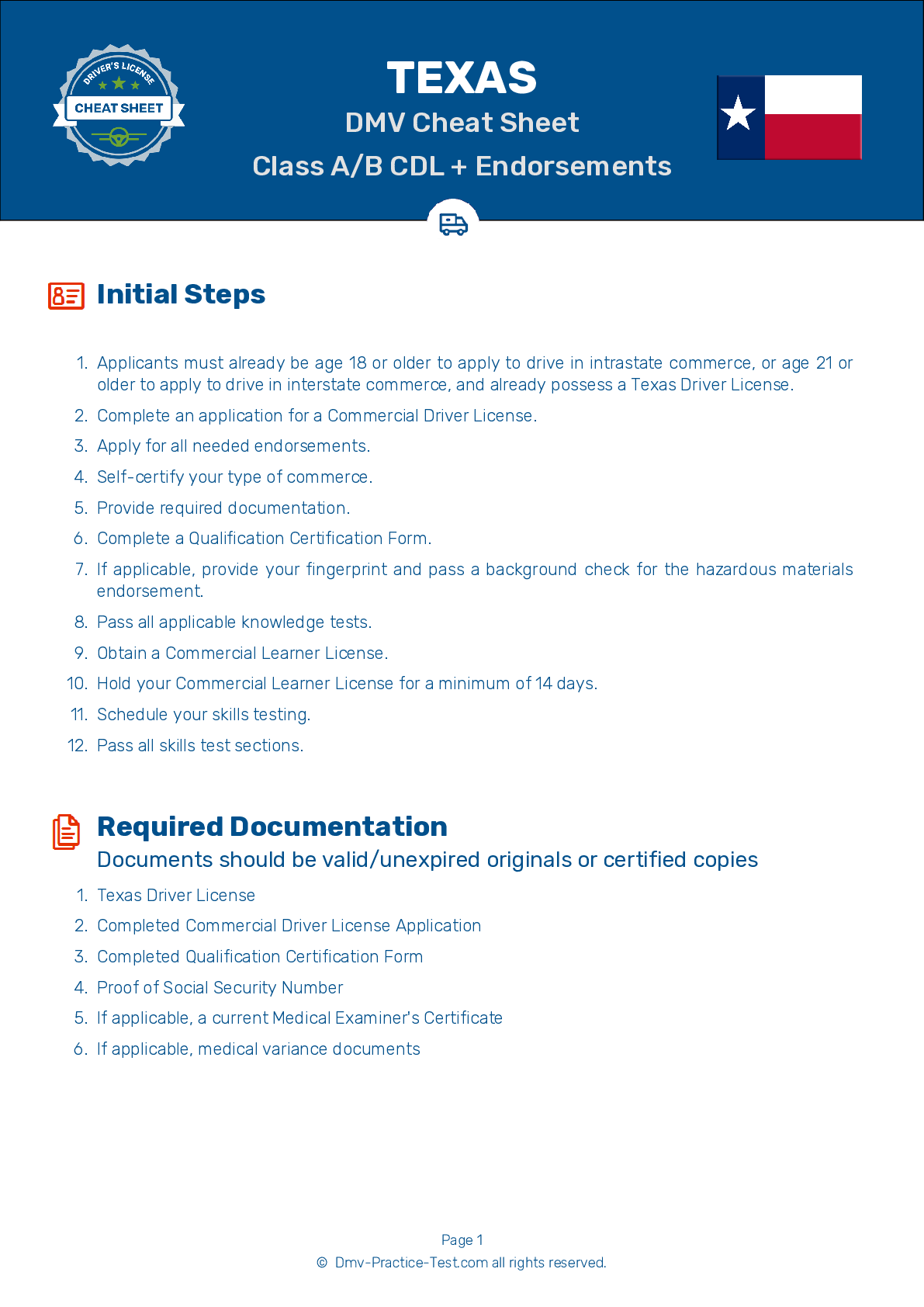
To acquire a CDL Hazmat endorsement in Texas, you must first have a Commercial Driver's License (CDL). Then, pass the Hazardous Materials Endorsement Knowledge Test at a Texas Department of Public Safety office. After passing, you'll need to undergo a TSA background check. Once cleared, the endorsement will be added to your CDL.
To obtain a CDL Hazmat license, you must first hold a valid Commercial Driver's License (CDL). You must be at least 21 years old and have a clean driving record. You'll also need to pass the Hazardous Materials Endorsement Knowledge Test and undergo a TSA background check. Good vision and physical health are also prerequisites.
When applying for a CDL Hazmat endorsement, you will need your current CDL, proof of U.S. citizenship or legal status (like a birth certificate or green card), and proof of identity and Texas residency. You'll also need your Social Security card and a completed Application for Texas Driver License or Identification Card. Lastly, you'll need to pass a TSA background check.
Yes, there is a dedicated written test for the CDL Hazmat endorsement. Called the Hazardous Materials Endorsement Knowledge Test, it covers topics like loading and unloading hazardous materials, bulk packaging marking, driving and parking rules, and emergency response procedures. This test must be passed to obtain the Hazmat endorsement.
The written test for the CDL Hazmat endorsement covers a range of subjects related to hazardous materials. These include recognizing hazardous materials, safe loading and unloading procedures, proper use of placards and labels, emergency response procedures, driving and parking rules for hazardous materials, and understanding the associated risks and regulations.
Yes, acquiring a CDL Hazmat endorsement comes with additional charges. These include a fingerprinting fee for the required TSA background check, and an endorsement fee. The exact costs can vary, so it's recommended to check with your local Department of Motor Vehicles (DMV) or similar agency for the most accurate information.
Yes, obtaining a CDL Hazmat endorsement requires a background check and security clearance. The Transportation Security Administration (TSA) conducts the check, which includes fingerprinting and a review of criminal, immigration, and terrorism records. This process is necessary to ensure the safety and security of hazardous materials transportation.
Yes, specialized training is required for the CDL Hazmat endorsement. Applicants must pass a written test, and in some cases, a driving test with a vehicle that carries hazardous materials. Once passed, this endorsement is added to your Commercial Driver's License (CDL). Regular renewal of this certification is also required.
No, you cannot legally transport hazardous materials without a valid Commercial Driver's License (CDL) with a Hazardous Materials (Hazmat) endorsement in the United States. This requirement ensures that drivers have the necessary training and knowledge to handle such materials safely, protecting public safety and the environment.
Yes, you can add the CDL Hazmat endorsement to your current CDL. You don't need to apply for a new CDL. However, you must pass the Hazmat knowledge test, undergo a TSA background check, and pay the required fees. Once completed, the endorsement will be added to your existing CDL.