Air Brakes #1
Air Brakes Endorsement Test | Kansas 2025 #1
Train for FREE online with our Kansas CDL air brake test. The official exam test consists of several obligatory parts, with all of them checking your knowledge of different blocks of road rules. If you need to obtain a KS Class A/Class B driver license in 2025, practice as much as possible. Free sample tests published on our website will help you check and improve your knowledge and boost your grades. Please bear in mind that the requirements for CDL may vary from state to state.
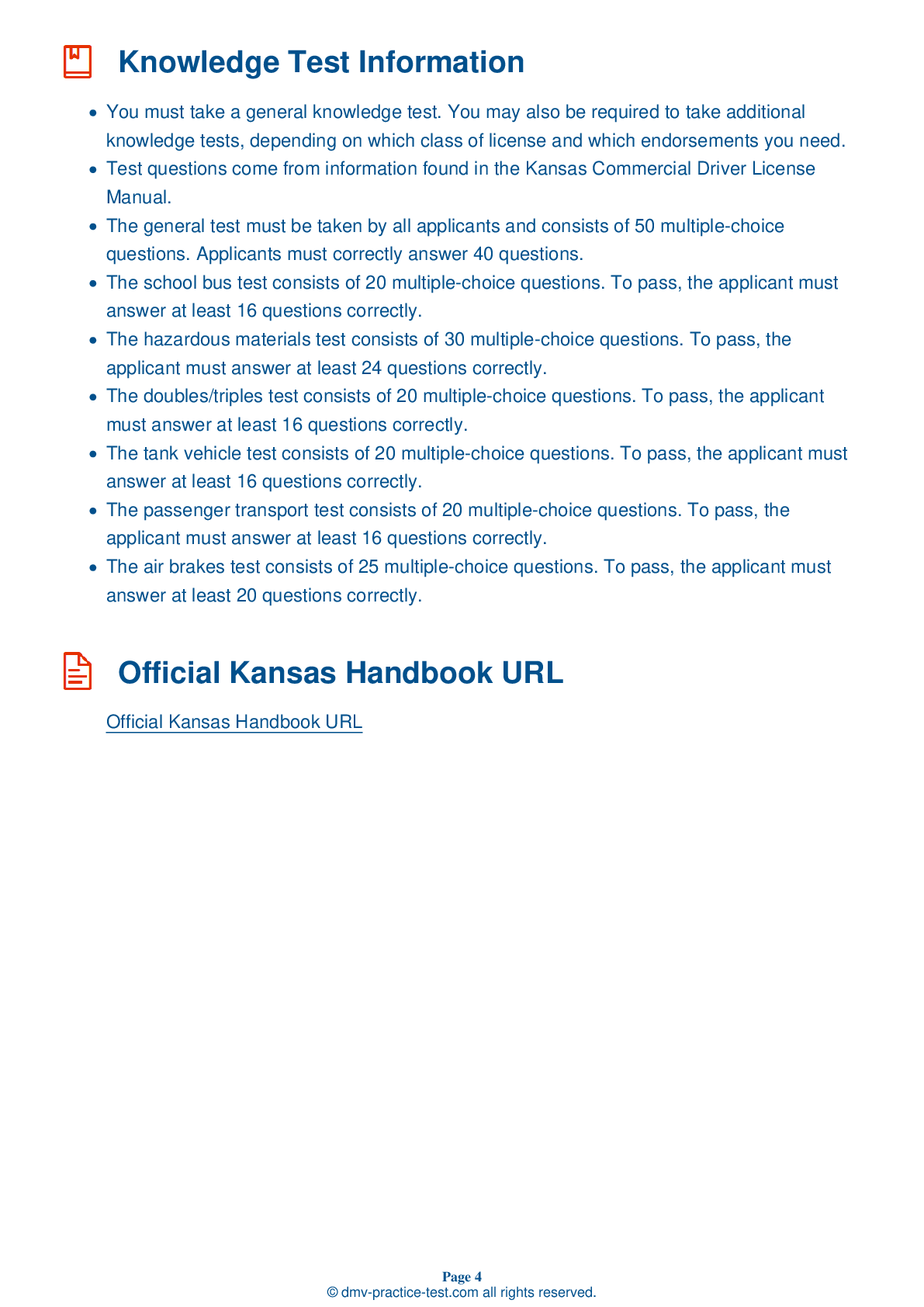
25
20
20
1 . Pressing and releasing a brake pedal unnecessarily can:
Create a loud noise.
In an air brake system, pressing and releasing the brake pedal unnecessarily can release air from the braking system faster than the compressor can replace it.
2 . Some air brake systems use alcohol:
To reduce the risk of rust forming on air brake valves.
Some air brake systems contain an alcohol evaporator. This device introduces alcohol into the braking system to inhibit the formation of ice.
3 . Truck tractors with air brakes built on or after March 1, 1997 must have:
A rear back-up camera.
Truck tractors with air brakes built on or after March 1, 1997 must be equipped with Anti-Lock Braking Systems (ABS).
4 . The air pressure in a dual air brake system should build from 85 to 100 psi within:
45 seconds.
When inspecting a vehicle with a dual air brake system, you should wait for air pressure to build from 85 to 100 psi in both the primary and secondary systems. This should take about 45 seconds.
5 . Friction inside a brake drum is caused when the brake shoes and linings:
Create excess heat.
Friction inside a brake drum is caused when the brake shoes and linings push against the inside of the drum. The friction in the drums will slow and stop the vehicle.
6 . Before starting down a hill, be sure to:
Switch into a low gear.
Before starting down a hill, be sure to switch into a low gear. Gravity will increase your vehicle's speed as you travel downhill.
2025 Kansas | Frequently Asked Questions
A Class B Commercial Driver's License (CDL) in Kansas allows you to operate single vehicles with a gross vehicle weight rating (GVWR) of 26,001 pounds or more, or any such vehicle towing another not exceeding 10,000 pounds. This typically includes straight trucks, buses, dump trucks, delivery trucks, and garbage trucks. It does not include combination vehicles, such as tractor-trailers.
A Class B Commercial Driver's License (CDL) in Kansas allows operation of single vehicles with a gross vehicle weight rating (GVWR) of 26,001 pounds or more, or any such vehicle towing another not exceeding 10,000 pounds. This typically includes straight trucks, buses, dump trucks, delivery trucks, and garbage trucks. It does not cover combination vehicles like tractor-trailers.
In Kansas, to acquire a Class B CDL, applicants must be at least 18 years old (21 for interstate driving), possess a valid non-commercial driver's license, pass a vision test, and then pass the written general knowledge test. After that, they must pass a pre-trip vehicle inspection test, basic vehicle control test, and on-road driving test in the type of vehicle they plan to drive.
In Kansas, you must be at least 18 years old to qualify for a Class B Commercial Driver's License (CDL) for intrastate driving, which means driving only within Kansas. However, to qualify for interstate driving (driving across state lines or transporting cargo that will be delivered out of state), you must be at least 21 years old.
Specific endorsements are not necessary to obtain a Class B CDL license but can be added based on the type of vehicle you wish to operate or the cargo you'll be transporting. For example, endorsements are available for passenger vehicles (P), school buses (S), and hazardous materials (H). Each endorsement requires passing additional tests.
The Class B CDL skills assessment in Kansas includes a pre-trip vehicle inspection test to check your understanding of your vehicle and its safety. The basic vehicle control test evaluates your ability to handle, steer, brake, and shift gears. Lastly, the on-road driving test assesses your ability to drive the vehicle in various traffic situations, including turns, intersections, railway crossings, and public roads.
Yes, Class B CDL license holders in Kansas are restricted to driving single vehicles with a gross vehicle weight rating (GVWR) of 26,001 pounds or more, or towing a vehicle not exceeding 10,000 pounds GVWR. They cannot operate Class A vehicles unless they've obtained the appropriate endorsements. Also, if the vehicle is used to transport hazardous materials or more than 15 passengers, additional endorsements are required.
No, in Kansas, the written Class B CDL test is only available in English. This is due to Federal Motor Carrier Safety Administration regulations stating that all commercial drivers must be able to read and understand English to ensure safety on the roads. Therefore, all tests are administered in English only.
Yes, in Kansas, accommodations can be requested for the Class B CDL written test if you have a disability. The request should be made at the time of scheduling your test. Accommodations may include extended time, a quiet room, or other necessary adjustments. It's crucial to provide adequate documentation of your disability when you make your request.
Yes, you can retake the Class B CDL written test in Kansas if you don't pass on your first try. You are allowed to retake the test one day after your initial attempt. However, if you fail the test three times, you will have to wait six months before you can retake it. Each retest may also require an additional fee.