Air Brakes #2
Air Brakes Endorsement Test | Idaho 2025 #2 Page 2 of 4
Train for FREE online with our Idaho CDL air brake test. The official exam test consists of several obligatory parts, with all of them checking your knowledge of different blocks of road rules. If you need to obtain a ID Class A/Class B driver license in 2025, practice as much as possible. Free sample tests published on our website will help you check and improve your knowledge and boost your grades. Please bear in mind that the requirements for CDL may vary from state to state.
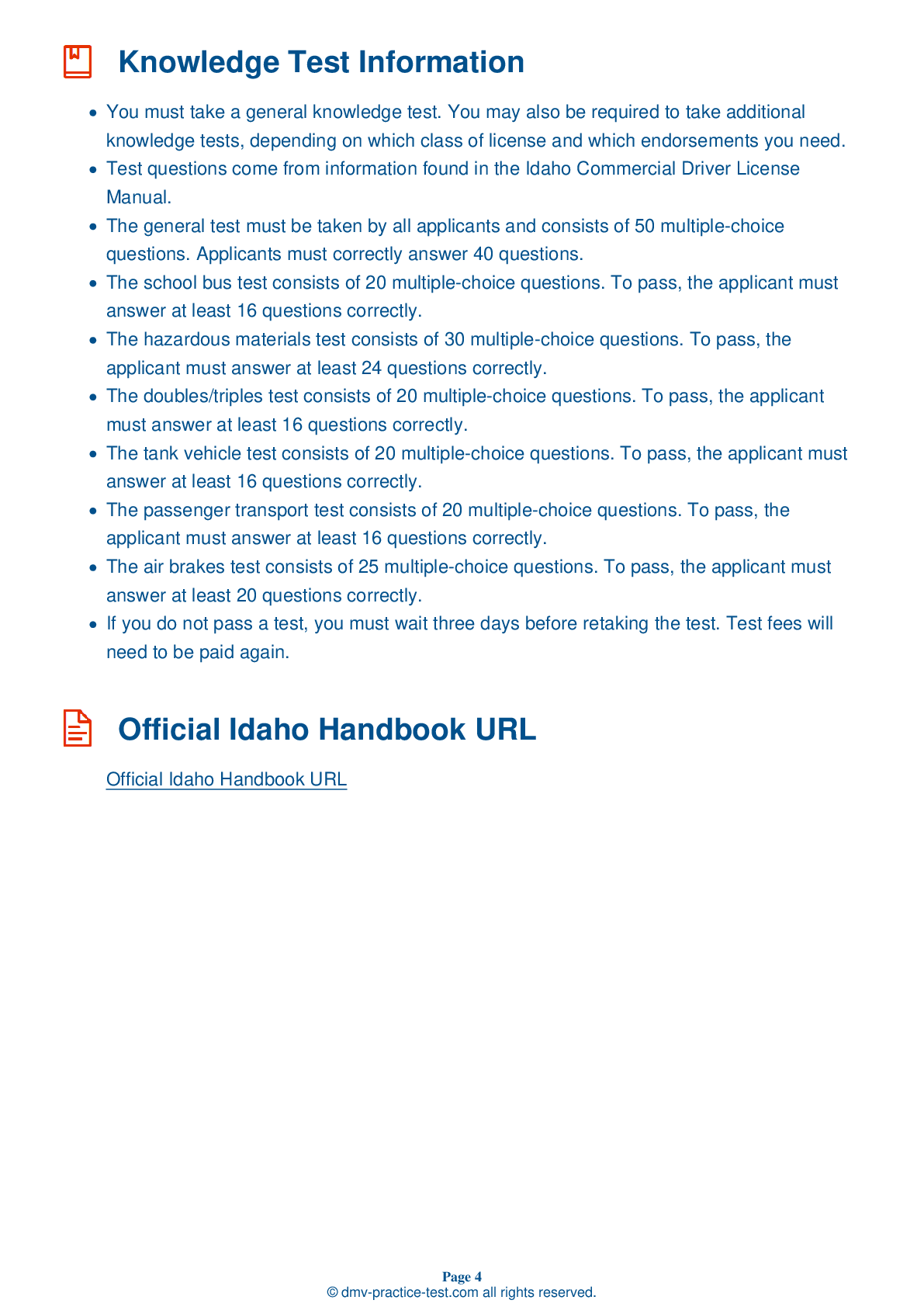
25
20
20
7 . Once the air tanks are at an air pressure level of 125 psi, the air compressor governor will:
An air compressor governor will stop the compressor from pumping air once the air tanks are at an air pressure level around 125 psi. This air pressure level is referred to as the "cut-out" level.
8 . What is brake lag?
Because air takes time to flow through the air lines to the brakes, air brakes cannot begin working instantly. There is often a brake lag of at least one-half of a second between the moment the brake pedal is pressed and the moment the brakes begin to work.
9 . The rods in S-cam brakes move the slack adjusters when air pressure is added to the brake chambers. This air pressure is added to the chambers when the driver:
When pressing the brake pedal in a vehicle with S-cam brakes, air will enter the brake chambers. The added air pressure will push out the rods and move slack adjusters, twisting the brake camshafts.
10 . When parked on a flat surface, you should:
When parking on a level surface, you should use wheel chocks. If the vehicle is not equipped with spring brakes, this is essential to prevent the trailer from moving.
11 . Why do large vehicles use air brakes?
If used and maintained properly, air brakes are a safe and effective way to stop large, heavy vehicles.
12 . In a dual air brake system, air pressure should build from 85 to 100 psi within ____ seconds.
When inspecting a vehicle with a dual air brake system, you should wait for air pressure to build from 85 to 100 psi in both the primary and secondary systems. This should take about 45 seconds.
2025 Idaho | Frequently Asked Questions
To secure a CDL Doubles/Triples endorsement in Idaho, you need to have a valid commercial driver's license (CDL). You will then need to pass the Doubles/Triples Knowledge Test offered by the Idaho Transportation Department. It's also recommended to practice with a qualified trainer before the test to ensure you understand how to safely operate these types of vehicles.
To obtain a CDL Doubles/Triples license, you must already hold a Commercial Driver's License (CDL). You'll need to pass the Doubles/Triples Knowledge Test, which covers coupling and uncoupling, inspecting doubles and triples, and checking air brakes. It's also recommended to have some hands-on training with a qualified instructor to ensure you can safely operate these vehicles.
While Idaho does not specifically require specialized experience or training for a CDL Doubles/Triples endorsement, it is highly recommended. Understanding how to handle these types of vehicles, how to couple and uncouple, and inspecting the vehicle are crucial. This knowledge can be gained through hands-on training with a qualified instructor and studying the CDL manual.
Yes, to obtain a CDL Doubles/Triples endorsement in Idaho, you are required to pass the Doubles/Triples Knowledge Test. This written exam focuses on the specific knowledge and skills needed to safely operate double and triple trailers, including coupling and uncoupling, vehicle inspections, and managing cargo.
During the CDL Doubles/Triples endorsement test in Idaho, you won't have to showcase specific driving skills or maneuvers. The test is knowledge-based and covers topics like coupling and uncoupling, inspecting doubles and triples, and managing cargo. However, practical skills like safely driving, turning, and parking these vehicles are crucial for real-world application.
No, it is not permissible to operate double or triple trailers without a valid CDL Doubles/Triples endorsement in Idaho. This endorsement is required by federal and state law to ensure that drivers have the necessary skills and knowledge to safely operate these larger, more complex vehicles. Operating without the endorsement can result in fines and penalties.
You can append the CDL Doubles/Triples endorsement to your current commercial driver's license. You don't need to initiate a new application for a CDL. However, you must pass the Doubles/Triples Knowledge Test. Once passed, the endorsement will be added to your existing CDL.
Drivers with a CDL Doubles/Triples endorsement must adhere to specific rules. These include restrictions on the maximum combined length of the trailers and the requirement to only drive these vehicles on designated highways. Also, they must follow all general CDL regulations, including hours of service rules, vehicle inspection requirements, and maintaining a clean driving record.
In Idaho, the maximum weight for a commercial vehicle, including double or triple trailers, is 105,500 lbs. The maximum length for a double trailer is 61 feet for the two trailers combined. Triple trailers are not generally permitted except on designated highways and they cannot exceed 95 feet in total length. These restrictions can change, so always check the current regulations.
Yes, there are specific safety guidelines for driving double/triple trailers. Drivers must maintain a safe following distance, anticipate stops, and avoid sudden lane changes. They should also be mindful of the "crack-the-whip" effect during turns. Regular vehicle inspections are mandatory to ensure brake system integrity and correct weight distribution. Additionally, drivers must comply with all CDL rules and federal regulations.