Knowledge Test Class A #2
Class A Driving Test | Florida 2026 #2
Train for FREE online with our Florida class A license test. The official exam test consists of several obligatory parts, with all of them checking your knowledge of different blocks of road rules. If you need to obtain a FL CDL class A permit in 2026, practice as much as possible. Free sample tests published on our website will help you check and improve your knowledge and boost your grades. Please bear in mind that CDL class A requirements may vary from state to state.
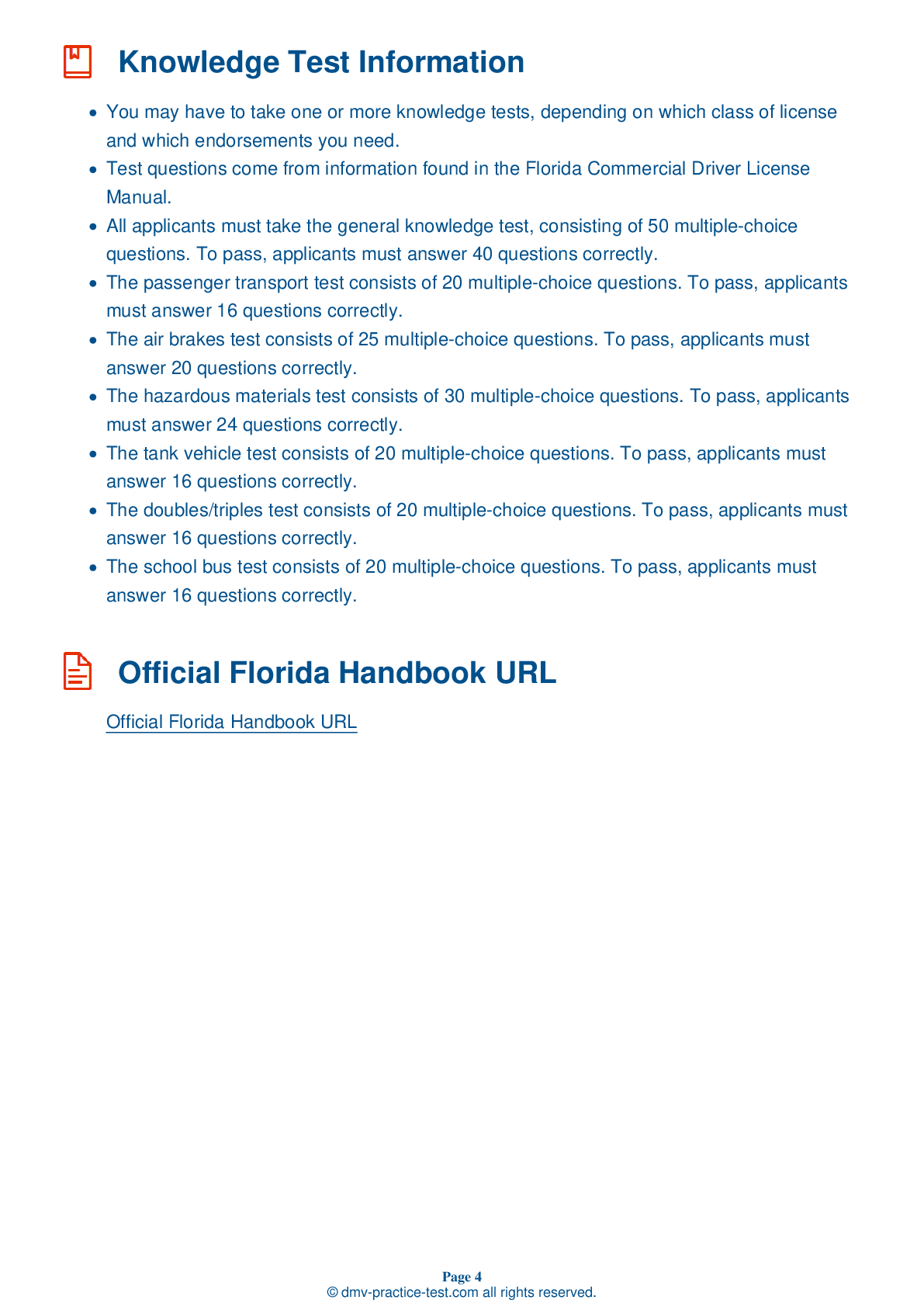
50
40
20
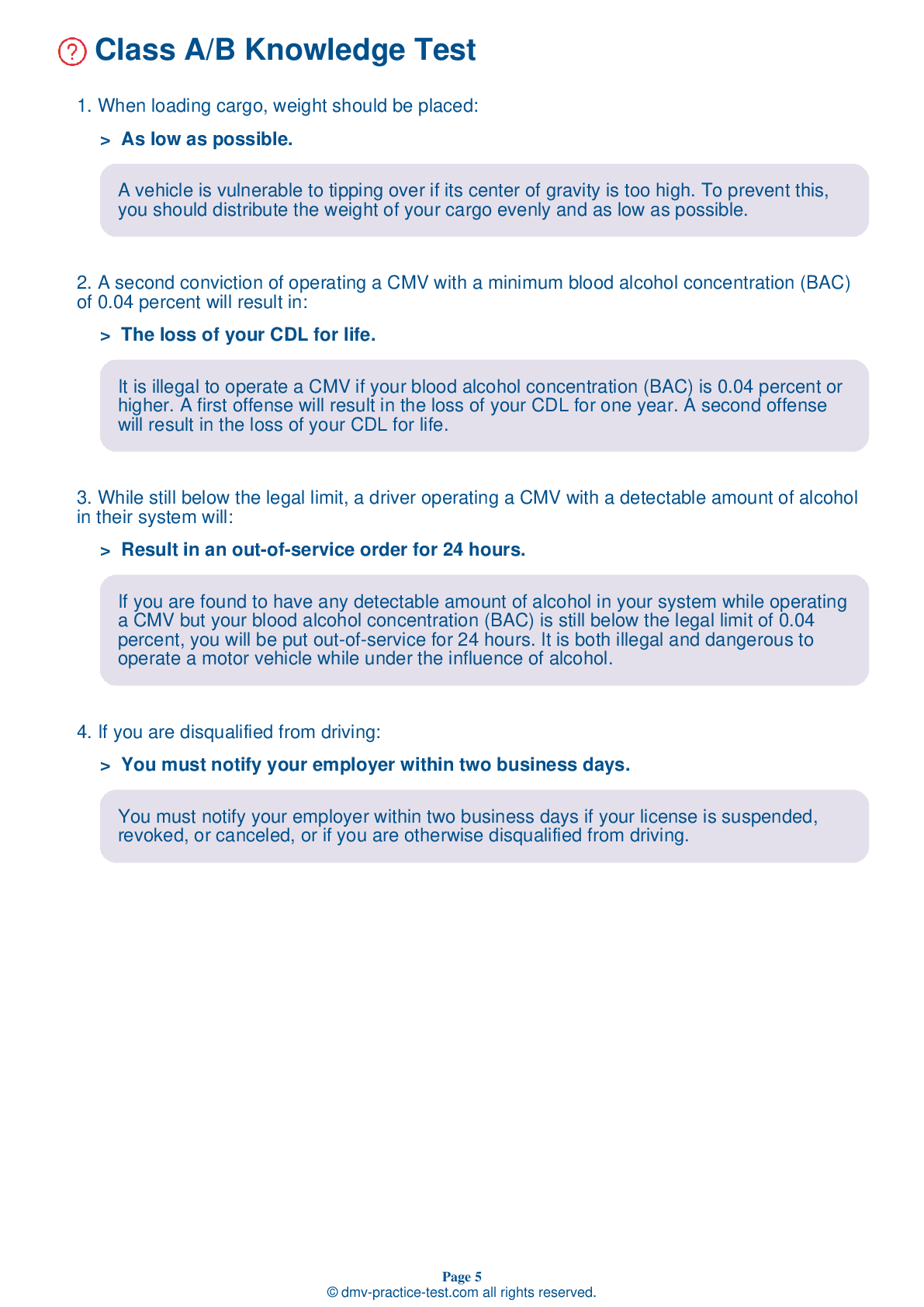
1 . You may:
A person cannot have more than one driver license at a time. States share information through a computer database to ensure that no person has more than one license. Violation of this law could result in fines or jail time.
2 . Applicants wishing to obtain a hazardous materials endorsement must be at least:
You must be at least 21 years old to qualify for a hazardous materials endorsement.
3 . You will often have to drive your vehicle under bridges and overpasses. If approaching such an opening, you should:
Do not assume that posted height clearances are accurate. If the road was repaved after the sign was posted, or if there is packed snow on the ground, the actual height of the opening may be different than what is indicated. If you are not confident that your vehicle will be able to safely clear an upcoming bridge or overpass, you should slow down and find another path, if possible.
4 . If there is a fire in your vehicle and you are not sure how to extinguish it, you should:
If you are not sure which method to use when putting out a fire, do not attempt to extinguish the fire on your own. Instead, wait for firefighters to arrive and let them handle it. This is especially true if you are experiencing a hazardous materials fire.
5 . When taking the on-road driving skills test:
CDL skills tests, including the on-road test, must be taken with the type of vehicle for which you want to be licensed.
6 . If a truck is equipped, a trailer brake hand valve can be used to:
Load cargo.
If a tractor-trailer is so equipped, the trailer brake hand valve can be used to stop the vehicle from rolling back when being started from a stop.
7 . Drivers can get traveler information by dialing what number on their phone?
To access the Florida Department of Transportation's free Traveler Information System, you can dial the number 511 on your phone. The system is updated with information about crashes, commuter travel times, congestion, lane closures, severe weather, construction, and emergency evacuation information on Florida’s interstate highways, toll roads, and other metropolitan roadways.
2026 Florida | Frequently Asked Questions
To secure a CDL Doubles/Triples endorsement in Florida, you must already have a Commercial Driver's License (CDL). You'll need to pass the Florida doubles/triples endorsement written test, which covers topics like coupling and uncoupling, inspecting doubles and triples, and handling. After passing the test, you'll receive your endorsement. Remember, driving experience with larger vehicles can be beneficial.
To obtain a CDL Doubles/Triples license, you must already have a Commercial Driver's License (CDL). You'll need to pass the doubles/triples endorsement written test. This test covers topics like coupling and uncoupling, inspecting doubles and triples, and handling. You might also need to demonstrate practical skills. Prior experience with larger vehicles may be beneficial.
While specialized experience or training isn't a legal requirement for a CDL Doubles/Triples endorsement, it's highly recommended. This endorsement involves handling larger, more complex vehicles. Understanding coupling and uncoupling, inspecting doubles and triples is crucial. Many applicants find it helpful to take a training course before attempting the written test to increase their chances of passing.
Yes, an extra written test is required to obtain a CDL Doubles/Triples endorsement in Florida. This test covers specific topics related to driving double and triple trailers, such as coupling and uncoupling, inspecting these types of trailers, and safe driving practices. Practical exams may also be required depending on the applicant's experience and competence.
The CDL Doubles/Triples endorsement test is a written exam, so no physical driving skills or maneuvers are required. The test focuses on knowledge of specific areas such as understanding the different parts of the vehicle, how to couple/uncouple trailers, inspecting doubles/triples, and understanding the handling and stability issues associated with these types of vehicles.
No, it's not permissible. In Florida, like in all U.S. states, drivers must have a valid CDL with a Doubles/Triples endorsement to legally operate double or triple trailers. Operating such vehicles without the proper endorsement can result in serious penalties, including fines and suspension of your commercial driving privileges.
Yes, you can append the CDL Doubles/Triples endorsement to your current commercial driver's license. You don't need to initiate a new application for a whole license. However, you will need to pass the appropriate knowledge test and pay the required fee for the endorsement. Remember, driving skills may also be assessed depending on your state's regulations.
Yes, there are constraints for drivers holding a CDL Doubles/Triples endorsement in Florida. Drivers must not exceed the maximum weight limit of 80,000 pounds and the maximum length of each trailer should not exceed 28.5 feet. Also, drivers are required to conduct regular inspections and maintain a logbook of their driving hours to ensure compliance with federal regulations.
Florida adheres to federal size regulations for Interstate highways, which limit the overall length of doubles to 28.5 feet per trailer and triples to 28.5 feet for the first two trailers. The maximum weight for a vehicle is typically 80,000 pounds depending on axle spacing. However, special permits may allow larger sizes or weights under certain circumstances.
Yes, drivers with a CDL Doubles/Triples endorsement must follow specific safety guidelines. These include conducting pre-trip inspections, understanding safe driving rules such as avoiding sudden movements, maintaining a safe following distance, checking brakes regularly, and understanding the complexities of backing up double/triple trailers. Additionally, they must comply with all FMCSA (Federal Motor Carrier Safety Administration) regulations.