Knowledge Test Class B #1
Class B Driving Test | District Of Columbia 2026 #1 Page 7 of 7
Train for FREE online with our District Of Columbia class B license test. The official exam test consists of several obligatory parts, with all of them checking your knowledge of different blocks of road rules. If you need to obtain a DC CDL class B permit in 2026, practice as much as possible. Free sample tests published on our website will help you check and improve your knowledge and boost your grades. Please bear in mind that CDL class B requirements may vary from state to state.
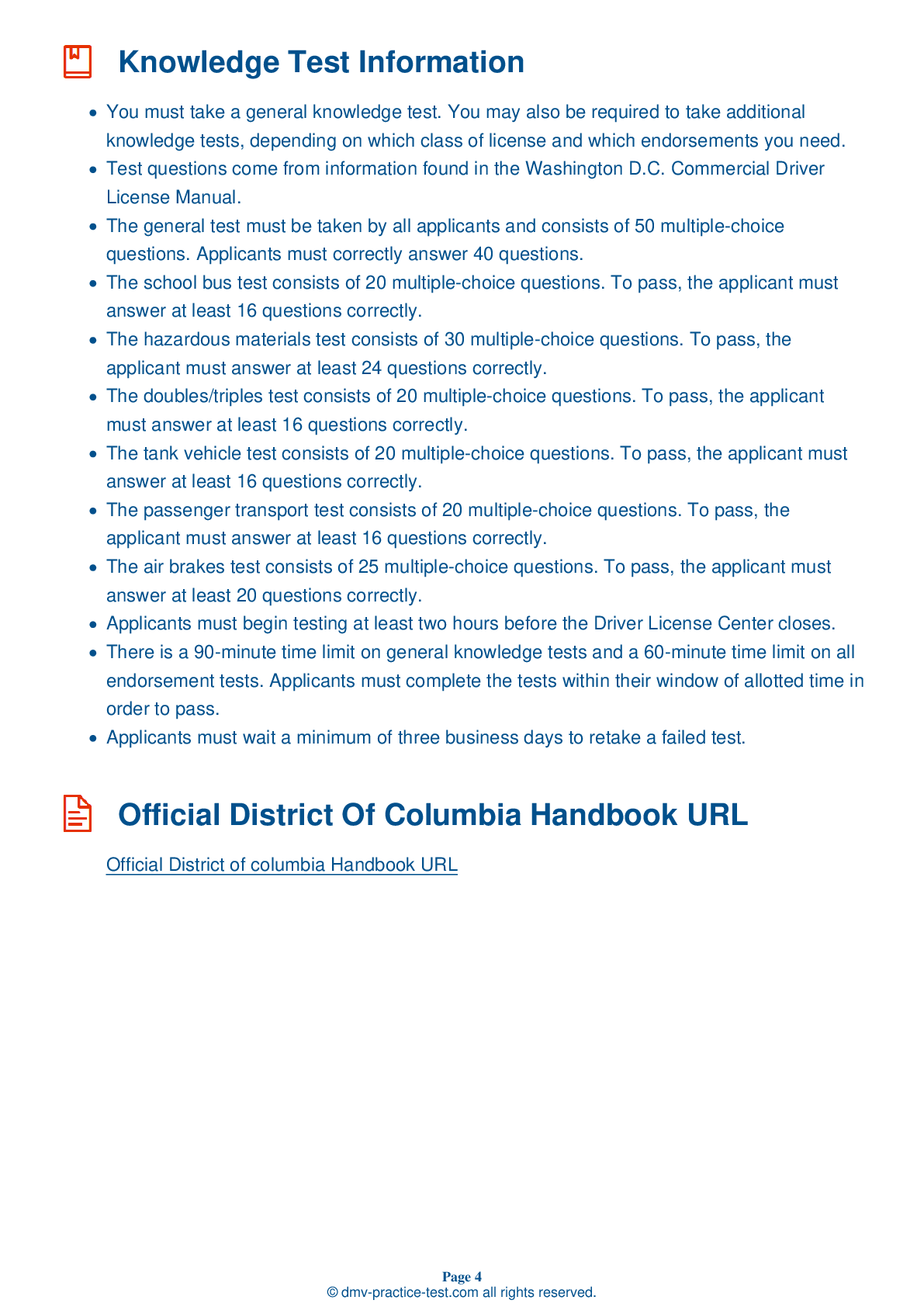
50
40
20
43 . After starting the engine, oil pressure should reach a normal level:
Within 10 minutes of driving.
After you start the engine, keep an eye on the gauges. Oil pressure should rise to a normal level within a few seconds of the engine being started.
44 . Texting while driving a CMV is:
Prohibited.
Texting while driving a commercial motor vehicle is both illegal and dangerous. Manually entering text into or reading text from any electronic device is considered texting.
45 . After traveling under an overpass during the driving skills test, you may be asked to recall:
If there was a shoulder near the roadway.
If you drive under an overpass during the on-road driving skills test, your examiner may ask you to recall the posted clearance or height of the overpass.
46 . When an engine is started:
The hood must be open.
After a vehicle is started, the warning lights and buzzers should go out after a few seconds. If the warning signals do not turn off, there may be something wrong with the vehicle.
47 . During a static leakage test, the maximum leakage rate for a single vehicle with air brakes is ____ in one minute.
4 psi
When performing a static leakage test on a single vehicle with air brakes, the leakage rate should be no more than 2 psi in a minute. If air leaks from the air brake system at a quicker rate, the vehicle should not be driven because something likely needs to be repaired.
48 . When a tire goes flat, you may hear a loud bang. The truck will be affected:
Only if the truck is hauling a load.
There may be a delay of a few seconds between the sound of a tire failing and the time that the vehicle is affected by the tire failure. Because of the short delay, a driver may initially believe that the sound came from another vehicle.
49 . Don't spend too much time looking at a single mirror because:
The mirror may not provide an accurate view of the road.
Check you mirrors frequently while driving, but check them quickly. Staring at one mirror for too long can cause you to drive a long distance without knowing what is ahead.
50 . How many daily hours of sleep does an adult need to maintain alertness?
Four to five
Being properly rested is essential to the safe operation of a CMV. To maintain alertness, most people need eight to nine hours of sleep per night.
2026 District Of Columbia | Frequently Asked Questions
To secure a CDL Doubles/Triples endorsement in the District of Columbia, you must first have a valid commercial driver's license (CDL). Then, you must pass the Doubles/Triples Knowledge Test. Once you pass this test, the endorsement will be added to your CDL. Please note that specific training may be required depending on your employer.
To obtain a CDL Doubles/Triples license in the District of Columbia, you need a valid CDL. You must then pass the Doubles/Triples Knowledge Test. Some employers may require specific training. It's also important to have a good driving record, as serious traffic violations could disqualify you from obtaining this endorsement.
While the District of Columbia doesn't specifically require specialized training for a CDL Doubles/Triples endorsement, you must pass the Doubles/Triples Knowledge Test. However, many employers prefer drivers with specific training or experience driving these types of vehicles. It's recommended to seek out training programs to increase your knowledge and skills.
Yes, to obtain a CDL Doubles/Triples endorsement in the District of Columbia, you must pass the Doubles/Triples Knowledge Test at the Department of Motor Vehicles (DMV). This test evaluates your understanding of the special skills and knowledge needed to safely operate these types of vehicles.
The CDL Doubles/Triples endorsement test primarily focuses on knowledge rather than specific maneuvers. You'll need to understand safety procedures, coupling and uncoupling, inspecting doubles and triples, and checking air brake systems. However, actual driving skills for these vehicles are typically evaluated by employers during training or probation periods rather than during the endorsement test.
No, it is not permissible to operate double or triple trailers without a valid CDL Doubles/Triples endorsement in the District of Columbia. Driving these types of vehicles requires specific knowledge and skills, which are validated through the endorsement. Operating without the appropriate endorsement can result in fines, license suspension, or even legal action.
You can add the CDL Doubles/Triples endorsement to your existing CDL. You don't need to initiate a new application for a CDL. However, you must pass the Doubles/Triples knowledge test. After passing the test, the endorsement can be added to your current CDL. Always check with your local DMV for specific procedures and requirements.
Yes, there are certain limitations for drivers holding a CDL Doubles/Triples endorsement. They must only drive the specific types of vehicles for which they're endorsed. They're also required to adhere to safety regulations regarding weight, length, and cargo securement. Additionally, these drivers must comply with all federal and state regulations, including hours of service rules.
In the District of Columbia, a double trailer cannot exceed 61 feet in length and a triple trailer cannot exceed 75 feet. The maximum weight per axle is 20,000 pounds, and the total gross weight, including all trailers and the power unit, cannot exceed 80,000 pounds. Violating these limits can result in fines or penalties.
Yes, there are specific safety guidelines. Drivers must ensure their trailers are correctly coupled and the weight is properly distributed. They should make wider turns, maintain a safe following distance, and check all mirrors frequently. Additionally, drivers must follow all federal and state regulations related to hours of service, vehicle inspections, and hazardous materials if applicable.