Knowledge Test Class B #2
Class B Driving Test | Mississippi 2026 #2 Page 4 of 7
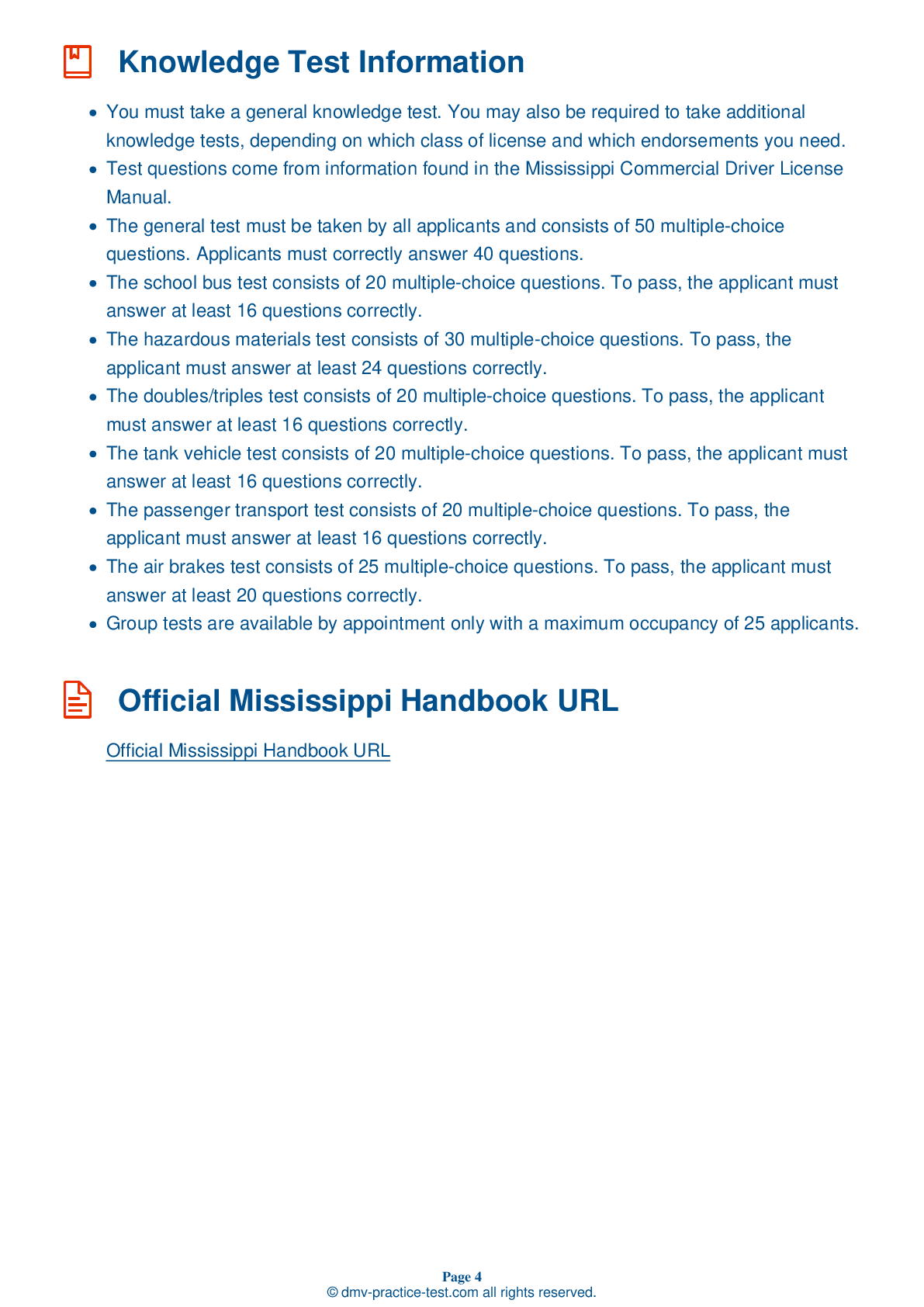
Train for FREE online with our Mississippi class B license test. The official exam test consists of several obligatory parts, with all of them checking your knowledge of different blocks of road rules. If you need to obtain a MS CDL class B permit in 2026, practice as much as possible. Free sample tests published on our website will help you check and improve your knowledge and boost your grades. Please bear in mind that CDL class B requirements may vary from state to state.
50
40
20
22 . What color malfunction lamps do vehicles equipped with ABS have?
Anti-Lock Braking System (ABS) malfunction lamps are usually yellow. Even if the ABS isn't working properly, a driver will still have access to the vehicle's usual braking functions.
23 . Brake linings should be:
Brake linings should not be loose or soaked with oil or grease. They shouldn't be dangerously thin.
24 . Using the brakes creates heat. If too much heat is produced:
Brakes are designed to take a lot of heat, but drivers should not rely solely on the brakes to slow their vehicle. Brakes may fade and lose their ability to slow down the vehicle if they become too hot, so drivers should also rely on the engine braking effect.
25 . An Anti-Lock Braking System (ABS):
Helps to ensure control while braking.
ABS increases a driver's control during braking. It will not necessarily change the distance needed for a vehicle to come to a complete stop.
26 . If involved in a crash, basic procedures should include all of the following, except:
Driving away without stopping.
If you are involved in a crash, the three basic things you need to do are protect the area, notify the proper authorities, and care for anyone injured. It is important to protect the accident site immediately after the accident occurs to help prevent another crash from happening in the same location.
27 . When driving under wet conditions, what does a lack of spray from other vehicles indicate?
The tires have soaked up all the moisture.
If the road appears to be wet but the wheels of other vehicles are no longer generating spray, ice has formed on the road. Drive with extra caution when operating on wet or icy roads.
28 . When passing a row of parked vehicles, a driver should:
You should be cautious when passing parked vehicles. A person may step out of a parked vehicle or out from between parked vehicles without looking for oncoming traffic. A driver may begin moving their vehicle before realizing you are there.
2026 Mississippi | Frequently Asked Questions
To acquire a CDL Hazmat endorsement in Mississippi, you must already possess a Commercial Driver's License (CDL). Then, pass the Hazardous Materials Knowledge Test at your local DMV. After passing, you'll need to undergo a TSA background check. Once cleared, pay the endorsement fee to have the Hazmat endorsement added to your CDL.
To obtain a CDL Hazmat license, you must first have a Commercial Driver's License (CDL). Then, you need to pass the Hazardous Materials Knowledge Test. You should be at least 21 years old, have no disqualifying criminal offenses, and pass a TSA Security Threat Assessment. It's also recommended to have good driving records and physical health.
When applying for a CDL Hazmat endorsement, you need to provide proof of U.S. citizenship or lawful permanent residency (like a passport or birth certificate), your valid Mississippi driver's license, and your Social Security number. You also need to submit a Medical Examiner's Certificate, proof of residency in Mississippi, and complete the TSA background check.
Yes, there is a dedicated written test for the CDL Hazmat endorsement. This test covers topics like loading and unloading hazardous materials, bulk packaging marking, driving and parking rules, and emergency response procedures. Passing this test is necessary to receive the Hazmat endorsement on your Commercial Driver's License (CDL).
The written test for the CDL Hazmat endorsement covers various subjects, including identification of hazardous materials, loading and unloading procedures, use of placards and labels, emergency response procedures, and federal regulations related to hazardous materials transportation. It also tests knowledge on the handling and transport of specific types of hazardous materials.
Yes, there are extra charges linked to acquiring a CDL Hazmat endorsement. Costs can include the application fee, fingerprinting fee, and background check fee. However, these fees can vary by state and the specific type of endorsement. It's recommended to check with your local DMV or similar agency for the most accurate and up-to-date information.
Yes, background checks and security clearances are mandatory for the CDL Hazmat endorsement. The Transportation Security Administration (TSA) conducts a federal background check, including fingerprinting. The applicant must not have any disqualifying criminal offenses. This process ensures that hazardous materials are transported safely and securely by trustworthy individuals.
Yes, specialized training is mandatory for the CDL Hazmat endorsement. Applicants must pass a written test to demonstrate knowledge of hazardous materials. After passing the test, they receive a certificate of completion. This certification is then used to obtain the Hazmat endorsement on a CDL. The endorsement must be renewed periodically, which may require additional training or testing.
No, you cannot legally transport hazardous materials without a valid CDL Hazmat endorsement in Mississippi. This endorsement is required by federal law and ensures that drivers are properly trained to handle and transport hazardous materials safely. Violating this law can result in severe penalties, including fines and suspension of your CDL.
Yes, you can add the CDL Hazmat endorsement to your current CDL license. You don't need to apply for a new license. However, you will need to pass a written test and undergo a TSA security threat assessment, which includes fingerprinting and a background check. Once you've passed these, the endorsement can be added to your existing CDL.