Bus #1
Bus Driver Testing | Texas 2026 #1 Page 2 of 3
Train for FREE online with our TX bus CDL test. The official exam test consists of several obligatory parts, with all of them checking your knowledge of different blocks of road rules. If you need to obtain a license in Texas in 2026, learn how to become a bus driver and then practice as much as possible. Free sample tests published on our website will help you check and improve your knowledge and boost your grades. Please bear in mind that DMV requirements for a bus driver may vary from state to state.
20
16
22
8 . If your vehicle is equipped with a cargo lift, you should ensure that:
The lift is the proper color.
When checking a cargo lift as part of your vehicle inspection test, you should check for leaking, damaged, or missing parts. The lift must be fully retracted and latched securely.
9 . When driving through a curve during the skills test, you should:
Reduce your speed before entering the curve.
When approaching a curve during the on-road driving skills test, you must reduce your speed sufficiently before entering the curve so that you do not need to further brake or shift in the curve. Keep the vehicle in its lane and continue to check for traffic in all directions.
10 . When entering traffic on an expressway during the skills test, you should:
Cut off other drivers if needed.
During the on-road driving skills test, you may be asked to enter an expressway. Before doing so, you must check traffic, use proper signals, and merge smoothly into the proper lane.
11 . When conducting a vehicle inspection, you will need to identify all of the following, except:
The water compressor belt.
During the vehicle inspection test, you must check the power steering belt, water pump belt, alternator belt, and air compressor belt for snugness, cracks, or frays. If any of these components are not belt-driven, you must tell the examiner which one(s), and verify that they are operating properly, mounted securely, and not damaged or leaking.
12 . During a vehicle inspection, be sure that:
The emergency exits are not accessible from inside the cab.
During the vehicle inspection test, you must ensure that any emergency exit warning devices are working. All emergency exits should operate smoothly, be undamaged, and close securely from the inside.
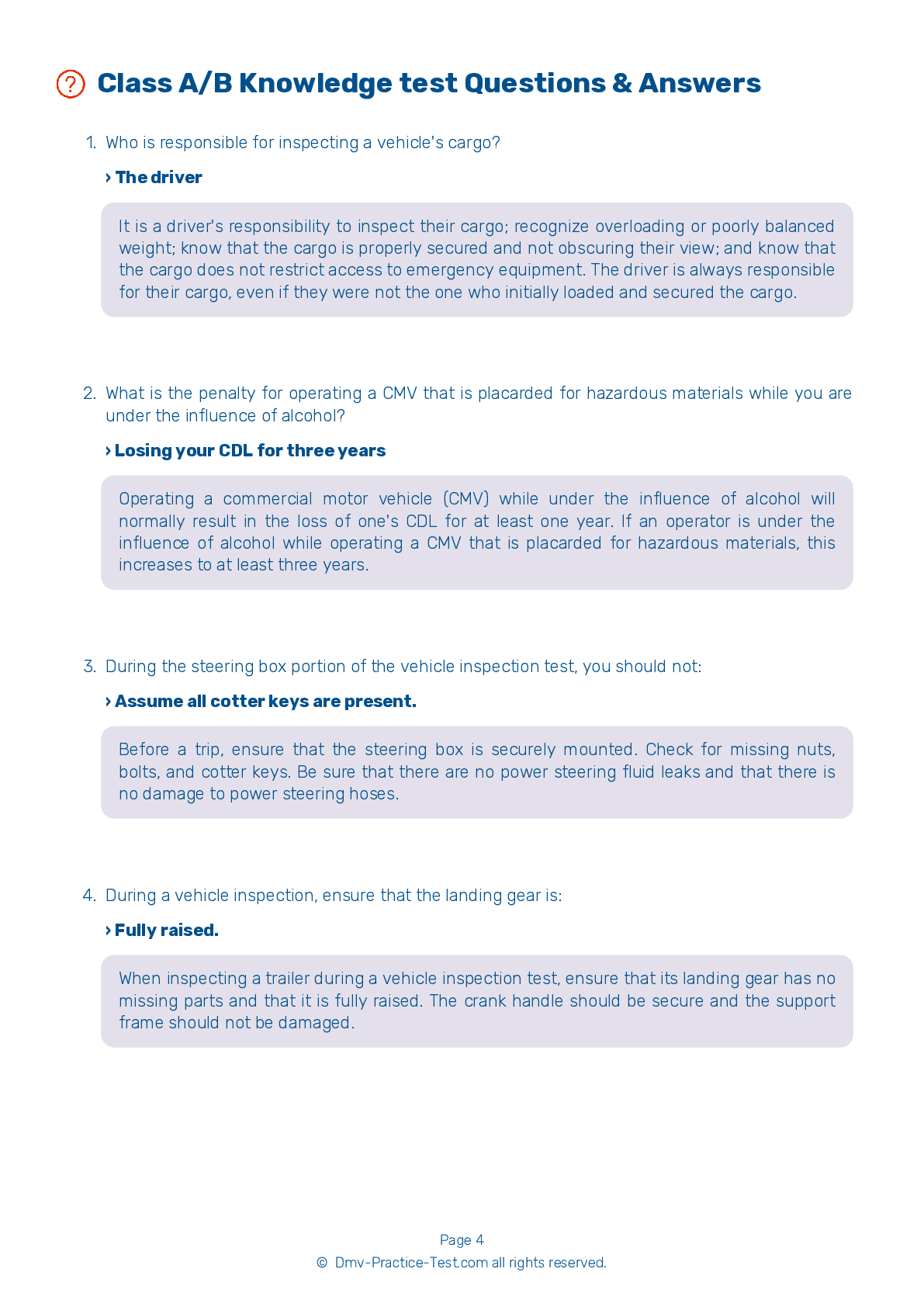
13 . During a vehicle inspection, ensure that the landing gear is:
Well lit.
When inspecting a trailer during a vehicle inspection test, ensure that its landing gear has no missing parts and that it is fully raised. The crank handle should be secure and the support frame should not be damaged.
14 . When crossing railroad tracks, you should:
Put the vehicle in neutral.
When crossing railroad tracks during the on-road driving skills test, you must not stop, change gears, pass another vehicle, or change lanes while any part of your vehicle is in the railroad crossing.

2026 Texas | Frequently Asked Questions
To acquire a CDL Hazmat endorsement in Texas, you must first have a Commercial Driver's License (CDL). Then, pass the Hazardous Materials Endorsement Knowledge Test at a Texas Department of Public Safety office. After passing, you'll need to undergo a TSA background check. Once cleared, the endorsement will be added to your CDL.
To obtain a CDL Hazmat license, you must first hold a valid Commercial Driver's License (CDL). You must be at least 21 years old and have a clean driving record. You'll also need to pass the Hazardous Materials Endorsement Knowledge Test and undergo a TSA background check. Good vision and physical health are also prerequisites.
When applying for a CDL Hazmat endorsement, you will need your current CDL, proof of U.S. citizenship or legal status (like a birth certificate or green card), and proof of identity and Texas residency. You'll also need your Social Security card and a completed Application for Texas Driver License or Identification Card. Lastly, you'll need to pass a TSA background check.
Yes, there is a dedicated written test for the CDL Hazmat endorsement. Called the Hazardous Materials Endorsement Knowledge Test, it covers topics like loading and unloading hazardous materials, bulk packaging marking, driving and parking rules, and emergency response procedures. This test must be passed to obtain the Hazmat endorsement.
The written test for the CDL Hazmat endorsement covers a range of subjects related to hazardous materials. These include recognizing hazardous materials, safe loading and unloading procedures, proper use of placards and labels, emergency response procedures, driving and parking rules for hazardous materials, and understanding the associated risks and regulations.
Yes, acquiring a CDL Hazmat endorsement comes with additional charges. These include a fingerprinting fee for the required TSA background check, and an endorsement fee. The exact costs can vary, so it's recommended to check with your local Department of Motor Vehicles (DMV) or similar agency for the most accurate information.
Yes, obtaining a CDL Hazmat endorsement requires a background check and security clearance. The Transportation Security Administration (TSA) conducts the check, which includes fingerprinting and a review of criminal, immigration, and terrorism records. This process is necessary to ensure the safety and security of hazardous materials transportation.
Yes, specialized training is required for the CDL Hazmat endorsement. Applicants must pass a written test, and in some cases, a driving test with a vehicle that carries hazardous materials. Once passed, this endorsement is added to your Commercial Driver's License (CDL). Regular renewal of this certification is also required.
No, you cannot legally transport hazardous materials without a valid Commercial Driver's License (CDL) with a Hazardous Materials (Hazmat) endorsement in the United States. This requirement ensures that drivers have the necessary training and knowledge to handle such materials safely, protecting public safety and the environment.
Yes, you can add the CDL Hazmat endorsement to your current CDL. You don't need to apply for a new CDL. However, you must pass the Hazmat knowledge test, undergo a TSA background check, and pay the required fees. Once completed, the endorsement will be added to your existing CDL.