Knowledge Test Class B #2
Class B Driving Test | Florida 2026 #2 Page 5 of 7
Train for FREE online with our Florida class B license test. The official exam test consists of several obligatory parts, with all of them checking your knowledge of different blocks of road rules. If you need to obtain a FL CDL class B permit in 2026, practice as much as possible. Free sample tests published on our website will help you check and improve your knowledge and boost your grades. Please bear in mind that CDL class B requirements may vary from state to state.
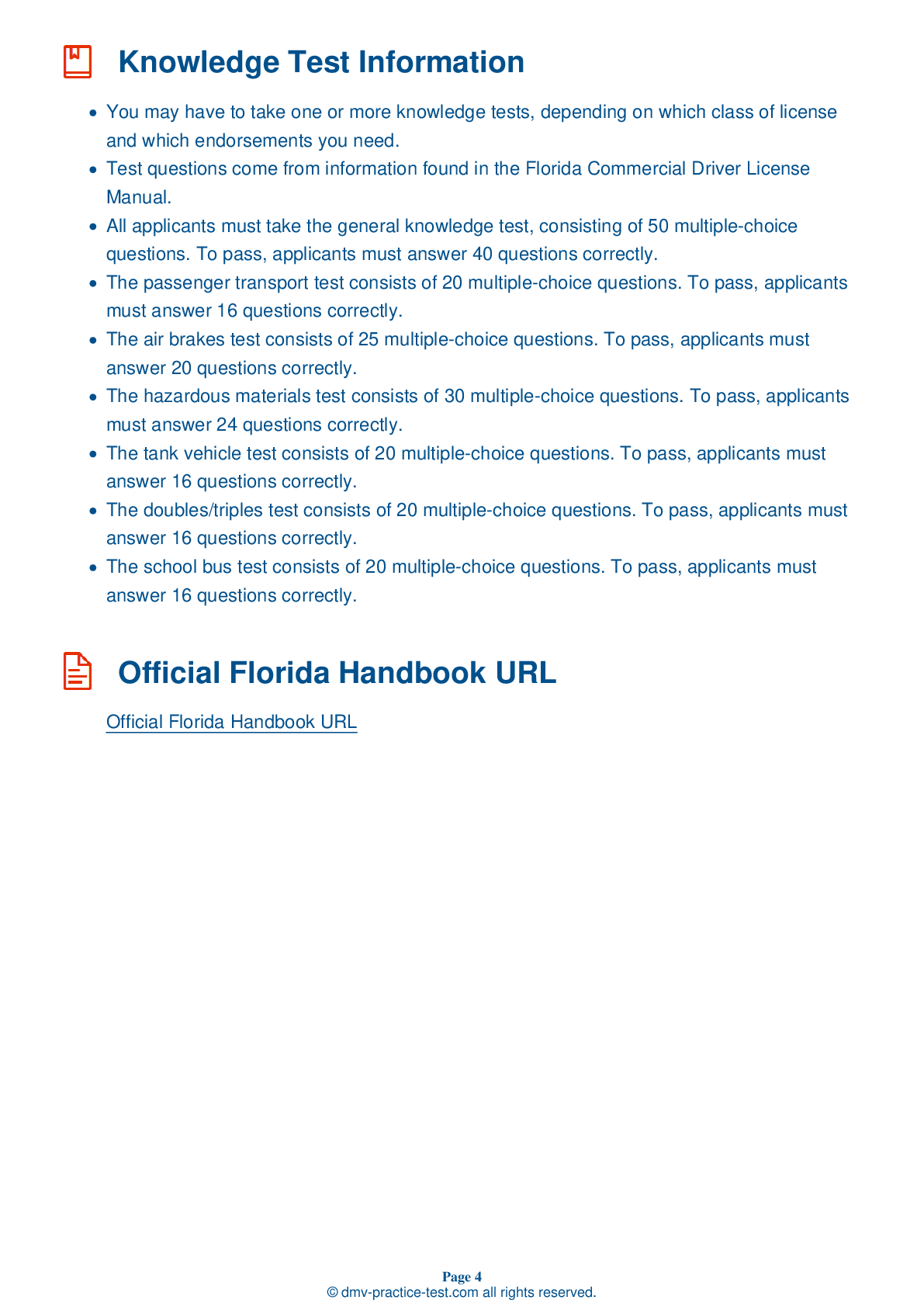
50
40
20
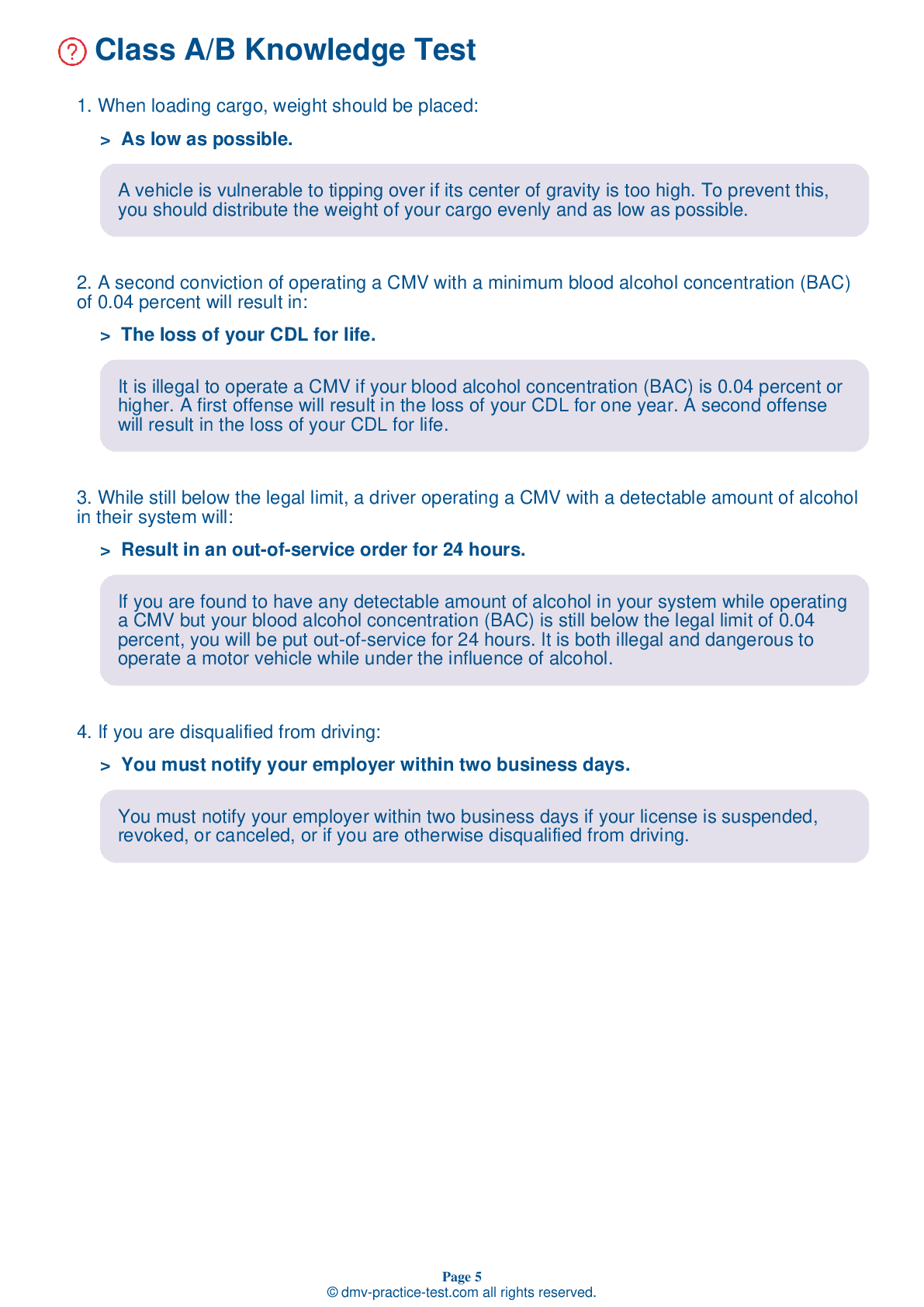
29 . A second conviction of operating a CMV with a minimum blood alcohol concentration (BAC) of 0.04 percent will result in:
It is illegal to operate a CMV if your blood alcohol concentration (BAC) is 0.04 percent or higher. A first offense will result in the loss of your CDL for one year. A second offense will result in the loss of your CDL for life.
30 . When loading cargo, weight should be placed:
A vehicle is vulnerable to tipping over if its center of gravity is too high. To prevent this, you should distribute the weight of your cargo evenly and as low as possible.
31 . Compared to talking on a cell phone while driving, texting while driving is:
Texting while driving is even more dangerous than speaking on a phone while driving. In addition to being mentally distracting, texting is also physically distracting.
32 . When encountering a railroad crossing during the driving test, you should:
During the on-road driving test, you must not stop, change gears, pass another vehicle, or change lanes while any part of your vehicle is in a railroad crossing.
33 . If driving through flowing water or a large puddle, you should:
It is best to avoid driving through large puddles or moving water. If there is no way to avoid driving through water, you should slow down, shift into a low gear, and gently apply the brakes. Pressing linings against the brake drums or discs will keep water, mud, silt, and sand from getting inside the brake mechanisms.
34 . During the driving test, the examiner will be scoring you on:
During the on-road driving test, the examiner will be score you on specific driving maneuvers as well as on your general driving behavior. You must drive in a safe and responsible manner; obey all traffic signs, signals, and laws; and not cause an accident or commit a moving violation.
35 . The more alcohol in the body:
The body removes alcohol at a fixed rate. The more alcohol consumed, the longer it will take for the body to remove the alcohol from its system.
2026 Florida | Frequently Asked Questions
To acquire a CDL Tank endorsement in Florida, you must first possess a valid Commercial Driver's License (CDL). Next, study the tank vehicle section of the Florida CDL manual. Then, schedule and pass the tank vehicle endorsement test at a Florida DMV office. This test includes multiple-choice questions about operating tank vehicles and transporting liquids.
To obtain a CDL Tank license, you must first have a valid Commercial Driver's License (CDL). You also need to pass the Tank Vehicle written test, which covers the specific rules and safety measures for tank vehicles. Studying the tank vehicle section in the CDL manual will help you prepare for this test.
Specific training or experience is not mandatory for a CDL Tank endorsement in Florida. However, it's important to thoroughly understand the tank vehicle operations and safety procedures. Studying the tank vehicle section of the Florida CDL manual is crucial. While not required, some applicants may find practical training beneficial for passing the endorsement test.
Yes, to obtain a CDL Tank endorsement in Florida, you must pass an additional written test. This test covers specific knowledge related to tank vehicle operation and safety procedures. It includes multiple-choice questions and is separate from the general CDL written test. The information for the test can be found in the Florida CDL manual's tank vehicle section.
The written test for the CDL Tank endorsement in Florida covers a variety of subjects including, but not limited to, inspecting tank vehicles, recognizing high and low center of gravity and its effects, understanding outage requirements, handling bulkheads, and safety procedures for driving and parking tank vehicles. The Florida CDL manual provides detailed information on these topics.
The CDL Tank endorsement assessment primarily focuses on knowledge rather than specific driving maneuvers. It tests your understanding of inspecting tank vehicles, recognizing high center of gravity and its effects, handling smooth bore tanks, emergency procedures, and dealing with special situations like crossing railroad tracks or long slopes.
Yes, there are certain limitations for drivers with a CDL Tank endorsement in Florida. They are only permitted to operate tank vehicles and are not allowed to haul hazardous materials unless they also possess a Hazardous Materials (HazMat) endorsement. Additionally, they must comply with all federal and state regulations regarding weight limits, vehicle inspections, and hours of service.
No, you cannot transport liquid or gas materials without a valid CDL Tank endorsement in Florida. This endorsement is necessary to operate a commercial vehicle that is designed to transport any liquid or gaseous materials within a tank or tanks having an individual rated capacity of more than 119 gallons and an aggregate rated capacity of 1,000 gallons or more.
The CDL Tank endorsement can be added to your current commercial driver's license in Florida. You don't need to apply for a fresh license, but you will need to pass the Tank Vehicle endorsement test. It's recommended to study the Florida CDL handbook and take practice tests before attempting the endorsement test.
Yes, there are specific regulations and prerequisites in place for handling hazardous materials with a CDL Tank endorsement in Florida. These include obtaining a hazardous materials endorsement, passing a written test, undergoing a background check, and completing a TSA threat assessment. Additionally, drivers must comply with federal regulations such as proper labeling, placarding, and handling of hazardous materials.