Knowledge Test Class B #2
Class B Driving Test | California 2026 #2 Page 5 of 7
Train for FREE online with our California class B license test. The official exam test consists of several obligatory parts, with all of them checking your knowledge of different blocks of road rules. If you need to obtain a CA CDL class B permit in 2026, practice as much as possible. Free sample tests published on our website will help you check and improve your knowledge and boost your grades. Please bear in mind that CDL class B requirements may vary from state to state.
50
40
20
29 . Which of the following is not a good rule when using turn signals?
When using your turn signals, you should signal well before the turn or lane change, signal continuously throughout the turn or lane change, and cancel the signal after you have completed your move.
30 . A pre-trip inspection should include:
When examining the engine compartment during a pre-trip inspection, you should check the engine oil level, the radiator coolant level, and the condition of the hoses.
31 . When backing with a trailer:
When backing, you should pull forward to reposition your vehicle whenever needed. Drift should be corrected immediately by turning the steering wheel in the direction of the drift.
32 . Which of the following is not required safety equipment for a commercial motor vehicle?
Emergency equipment that is required for commercial vehicles includes at least one fire extinguisher; spare electrical fuses, unless the vehicle is equipped with circuit breakers; and warning devices for parked vehicles, such as warning triangles, fuses, or liquid burning flares.
33 . Having weight loaded in a way that creates a high center of gravity:
Transporting cargo that is loaded with a high center of gravity increases the risk that the transporting vehicle will tip over. Cargo should be loaded with a safe weight distribution.
34 . What must be done if a load extends four or more feet beyond the rear of a truck?
If a load projects more than four feet beyond the rear of a vehicle's body, a solid red or fluorescent orange flag that is at least 12 square inches in size must be placed at the extreme end of the load.
35 . During an applied leakage test, the maximum leakage rate for a double combination vehicle is ____ in a minute.
It is important to know the maximum air loss rate that is safe for your specific vehicle. A double combination vehicle should have a leakage rate no higher than 4 psi in a minute during an applied leakage test.
Search the best driving school in your neighbourhood
2026 California | Frequently Asked Questions
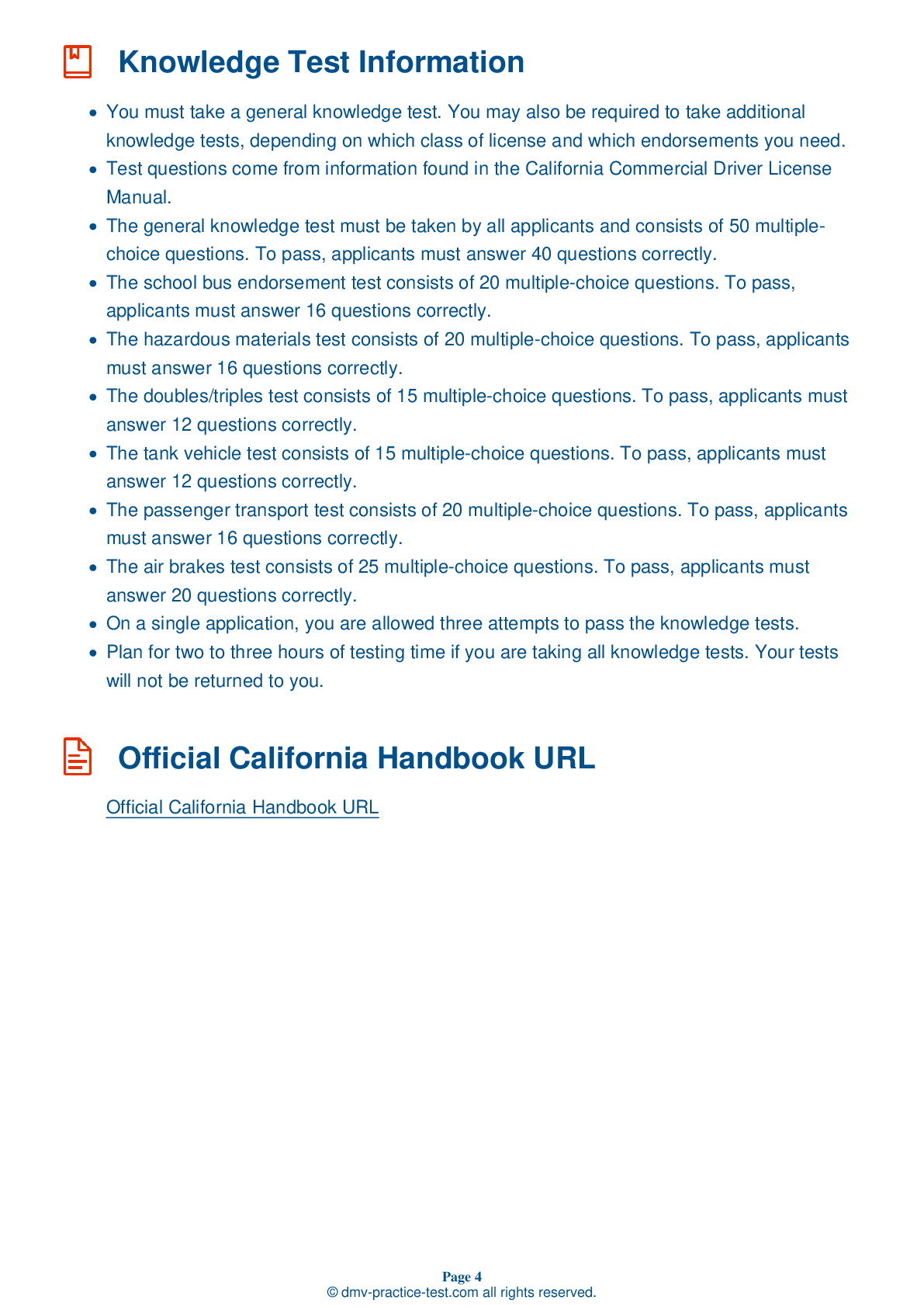
To obtain a CDL Tank endorsement in California, you must first have a Commercial Driver's License (CDL). Then, study the California CDL handbook's section on Tank Vehicles to prepare for the written test. Schedule and pass the written test at your local DMV. Once passed, you'll receive your Tank endorsement, allowing you to drive commercial tank vehicles.
To obtain a CDL Tank license, it's essential to first have a Commercial Driver's License (CDL). You must also study the tank vehicle section of the CDL handbook, pass a written test specific to tank vehicles, and pay the required fees. Knowledge of inspection procedures, driving techniques, and handling emergencies is crucial.
While California doesn't specifically mandate training or experience for a CDL Tank endorsement, it's highly recommended. Understanding the operation of tank vehicles, safety procedures, and how to handle emergencies is crucial. Studying the tank vehicle section of the CDL handbook and gaining practical experience will greatly improve your chances of passing the endorsement test.
Yes, to obtain a CDL Tank endorsement in California, you must pass the Tank Vehicle endorsement test. This written exam covers topics such as the inspection of tank vehicles, driving tank vehicles, and safe driving rules. It's an additional test beyond the general CDL exam and is required for the endorsement.
The written test for a CDL Tank endorsement covers subjects such as inspecting tank vehicles, safe driving for tank vehicles, and handling emergencies. This includes understanding the high center of gravity in these vehicles, the impact of liquid surge on vehicle control, and procedures for loading and unloading. Knowledge of specialized laws relating to tank vehicles is also tested.
The CDL Tank endorsement assessment doesn't involve a specific skills test or maneuvers like the basic CDL exam. Instead, it focuses on a written test that assesses your understanding of tank vehicle operations. This includes knowledge of safe driving techniques, handling liquid surge, emergency procedures, and how to properly inspect and maintain tank vehicles.
Yes, drivers with a CDL Tank endorsement must follow specific rules. These include weight restrictions for the vehicle, following hours of service regulations, and restrictions on hazardous materials transport if the driver doesn't hold a Hazmat endorsement. Violations can lead to CDL disqualification. It's crucial to understand and follow these regulations to maintain the endorsement.
No, drivers cannot transport liquid or gas materials without a valid CDL Tank endorsement. This endorsement is required for operating a commercial vehicle that is designed to transport any liquid or gaseous materials within a tank or tanks having an individual rated capacity of more than 119 gallons and an aggregate rated capacity of 1,000 gallons or more.
The CDL Tank endorsement can be added to your existing CDL. You don't need to apply for a new license. However, you will need to pass the Tank Vehicle written knowledge test. Once you pass, the Tank endorsement will be added to your current CDL, expanding the types of vehicles you're authorized to drive.
Yes, to handle hazardous materials with a CDL Tank endorsement, you must also have a Hazardous Materials (Hazmat) endorsement. This requires passing an additional written test and a Transportation Security Administration background check. It ensures drivers understand safety protocols for handling hazardous materials, reducing the risk of incidents.