Bus #1
Bus Driver Testing | Kansas 2026 #1 Page 3 of 3
Train for FREE online with our KS bus CDL test. The official exam test consists of several obligatory parts, with all of them checking your knowledge of different blocks of road rules. If you need to obtain a license in Kansas in 2026, learn how to become a bus driver and then practice as much as possible. Free sample tests published on our website will help you check and improve your knowledge and boost your grades. Please bear in mind that DMV requirements for a bus driver may vary from state to state.
20
16
20
15 . When loading a trailer, weight should be:
Placed only on the right side, if possible.
Weight of cargo should be loaded into a trailer as low as possible. If the weight of cargo is positioned too high in a trailer, it will put the vehicle at risk of tipping over.
16 . The inside rearview mirror of a school bus is used to:
See in front of the bus.
On a school bus, the overhead inside rearview mirror is used to monitor passenger activity inside the bus.
17 . Drivers are usually the least alert:
In the afternoon.
Drivers are usually less alert when driving at night, especially after midnight.
18 . A driver should always:
Drive above the speed limit.
While driving, you should continually scan the road to spot potential hazards in advance. Make emergency plans for how to deal with the hazards if they become dangerous.
19 . Poor weight balance:
Makes a vehicle easier to stop.
If the weight of a load is poorly balanced, it can lead to difficult and unsafe handling of a vehicle.
20 . If feeling sleepy while driving, you should:
Take an energy pill.
If you begin to feel sleepy while driving, the only safe response is to stop driving and get some sleep. Attempting to fight off exhaustion is dangerous and a major cause of fatal crashes. Stimulants are not a safe solution because they may help keep you awake but will not make you more alert. Once stimulants wear off, you will be even more tired than you were originally.
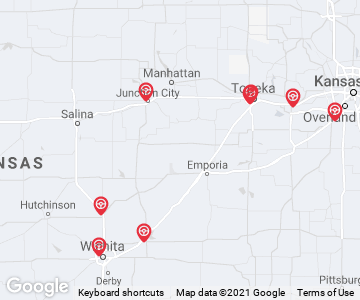
Search the best driving school in your neighbourhood
2026 Kansas | Frequently Asked Questions
To acquire a CDL Passenger endorsement in Kansas, you must first have a Commercial Driver's License (CDL). Next, you'll need to pass a written Passenger Vehicles test and a skills test in the type of vehicle you'll be driving. The Kansas Department of Revenue's Division of Vehicles oversees this process. It's advisable to study the Kansas CDL Handbook prior to testing.
To obtain a CDL Passenger license in Kansas, you must be at least 18 years old, possess a valid non-commercial driver's license, and have at least one year of driving experience. You must also pass a medical examination, a written Passenger Vehicles test, and a skills test in the type of vehicle you'll be driving.
While Kansas does not mandate specific training to secure a CDL Passenger endorsement, it is highly recommended. The endorsement requires passing a written test and a skills test in a vehicle similar to what you'll be driving. Therefore, training or experience driving such vehicles can be very beneficial. Additionally, you must have at least one year of driving experience to obtain a CDL.
Yes, to obtain a CDL Passenger endorsement in Kansas, you are required to pass a written Passenger Vehicles test. This test covers topics like vehicle inspection, loading and trip start, on the road, after-trip vehicle inspection, prohibited practices, and use of brake-door interlocks. It's an additional requirement beyond the general CDL written exam.
During the CDL Passenger endorsement assessment, you will need to demonstrate skills such as safe loading and unloading of passengers, proper operation of emergency exits, responding appropriately to emergency situations, and safely navigating routes. You'll also need to perform a vehicle inspection to ensure it's safe for passenger transport. Additionally, you'll be evaluated on your ability to manage passenger behavior.
No, you cannot legally transport passengers in Kansas without a valid CDL Passenger endorsement. This endorsement is necessary for drivers who wish to drive vehicles such as buses or shuttles that carry 16 or more passengers, including the driver. Driving without the proper endorsement can lead to serious penalties, including fines and suspension of your CDL.
Yes, you can add the CDL Passenger endorsement to your existing commercial driver's license. You don't need a new application. However, you must pass the Passenger endorsement knowledge test and in some cases, a skills test. Once you pass, the endorsement is added to your CDL. Check with your local DMV for specific requirements in Kansas.
Yes, there are specific restrictions for drivers with a CDL Passenger endorsement in Kansas. For example, you must not have any serious traffic violations within the past two years. Also, you're required to pass a background check by the Transportation Security Administration if you're driving a vehicle designed to carry 16 or more passengers. Lastly, you must be at least 21 to drive commercially across state lines.
Yes, in Kansas, you must be at least 18 years old to apply for a CDL Passenger endorsement for intrastate transport (within Kansas only). However, if you plan on driving commercially across state lines (interstate transport), or transporting hazardous materials, you must be at least 21 years old. Age limitations are set for safety and insurance reasons.
With a CDL Passenger endorsement in Kansas, you're eligible to operate vehicles designed to transport 16 or more passengers, including the driver. This includes buses, shuttles, and large vans. However, if the vehicle is also classified as a school bus, you will need an additional School Bus (S) endorsement. Always check the specific requirements for the vehicle you intend to operate.